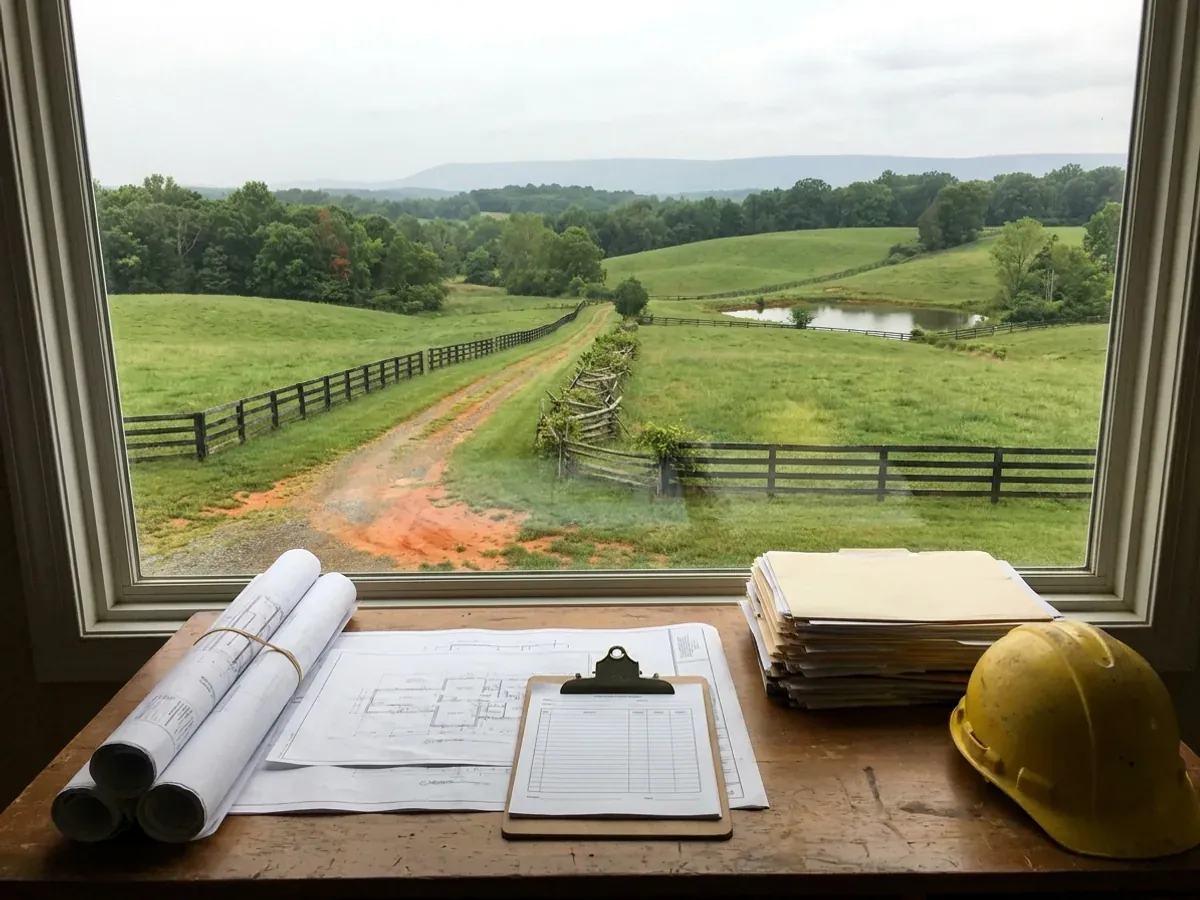
Permitting & Engineering in Virginia
These two go together because one is useless without the other. Virginia has one building code, the Board of Housing and Community Development is the only body that may amend it, and Va. Code § 36-105(A) makes local enforcement of it mandatory — so there is no unenforced corner of the Commonwealth and no locality writing its own rules. What is local is the arithmetic: Table R301.2 is printed blank and your jurisdiction fills it in. We do the structural engineering against the figures your jurisdiction actually publishes, then carry the set through submittal, the comment cycles and every inspection to the certificate of occupancy.
How a permitting & engineering project runs
Four stages, in this order. The sequence matters more than it looks: getting engineering and permitting settled before anything is fabricated is what keeps a build from stalling.
Jurisdiction and zoning check
First we establish who enforces on your land — a county, one of the 38 independent cities that sit in no county at all, or a town that has elected to run its own building department. Then the zoning, because that is where local power genuinely lives: Va. Code § 36-98 stops a locality regulating dwelling foundations, required building materials or finishes, or minimum window area by ordinance for single-family construction, but expressly does not override proffered conditions, conditions on a special exception or conditional use permit, overlay districts or historic districts. An appearance rule your county cannot impose generally can still be attached to your particular parcel.
Structural engineering
A Virginia-licensed professional engineer analyses the frame against the criteria your jurisdiction publishes, then seals the foundation, anchor bolt layout, framing and connection details. A clear-span barndominium is not covered by the residential code’s prescriptive tables, so VRC Section R301.1.3 sends those elements to accepted engineering practice and VCC Section 310.6.1.1 sends what the residential code does not address into the Virginia Construction Code.
Assemble and submit
Sealed plans, energy documentation, wind-load calculations, truss engineering, site plan, and the ancillary approvals reviewers ask for late. The septic authorisation is not one of the late ones — Va. Code § 32.1-165 bars a permit for a building designed for human occupancy until it is in hand. On fees, expect a locality-set schedule: the only permit-fee figure that is identical everywhere in Virginia is the 2.0% Building Code Academy levy the local building department collects and remits quarterly to DHCD.
Inspections through to CO
We answer review comments quickly, then schedule and meet the seven minimum inspections under USBC Section 113.3 — footing excavations before concrete, foundation systems, preparatory work before placement, structural members and fasteners, the mechanical and electrical and plumbing systems, energy conservation material, and the final. Three of those must happen before concealment, and two before concrete is placed. The certificate of occupancy follows under Section 116, within five working days of the final inspection being approved.
Virginia has 38 independent cities, and they belong to no county at all
You will read that Virginia permits are handled at the county level. That is the wrong map. Virginia has 133 county-level jurisdictions: 95 counties and 38 independent cities, and an independent city is not a place inside a county — it is a county equivalent with its own building department, its own zoning administrator and no county government above it. Alexandria, Richmond, Roanoke, Lynchburg, Harrisonburg, Winchester, Fredericksburg and 31 others are in this class. Separately there are 189 incorporated towns that do sit inside counties, and Va. Code § 36-105(A) lets a town under 3,500 people elect whether to administer the building code at all — if it does not, the county does it for the town. So the first real question on any Virginia project is which of three kinds of body has your parcel. What does not change is the code itself. § 36-98 makes the Uniform Statewide Building Code supersede the building codes and regulations of the counties, municipalities and other political subdivisions; § 36-102 vests the power to amend it in the Board of Housing and Community Development alone; and § 36-105(A) makes enforcement of it for new construction the local building department's responsibility, with no opt-out. The code is the same everywhere. Who reviews it, what they charge and the design criteria they publish are not.
Where we deliver permitting & engineering
In Virginia the city limit is a real boundary rather than a formality: thirty-eight Virginia cities are independent and sit in no county at all. The code is not what changes when you cross that line — the Uniform Statewide Building Code applies on both sides of it and enforcement is mandatory everywhere. What changes is who reviews the drawings, what they charge, how the land is zoned, and the criteria that locality has filled into Table R301.2. Two parcels twenty miles apart can carry completely different engineering.
Serving clients across the entire region.
Every locality we build in has its own reviewer, its own fee schedule and its own filled-in design criteria. The service area pages set out what each one publishes.
What actually decides the price
Square footage is the number everyone leads with, and it is rarely the one that moves a barndominium budget. These four do.
-
Which building department holds your parcel
There is no state-set dollar cap and no state fee schedule. Va. Code § 36-105(B) says fees are levied to defray the cost of enforcement, and 13VAC5-63-70 Section 107.1.1 requires each local governing body to establish a schedule of unit rates that may be based on square footage, cubic footage, estimated cost of construction or other criteria. Two neighbouring jurisdictions can price the same building very differently.
-
The one number that is identical statewide
Va. Code § 36-137(7) lets the Board levy up to two percent of permit fees to support the Virginia Building Code Academy, and 13VAC5-63-70 Section 107.2 sets the rate at 2.0%. The local building department collects it on top of its own fee and remits it quarterly to DHCD — unless the locality maintains a DHCD-accredited training academy, in which case it keeps it. Every other permit figure in Virginia is a local one.
-
How much of the design falls outside the prescriptive tables
VCC Section 310.6.1.1 sends any method, material, system or component for a Group R-5 structure that the Virginia Residential Code does not prescriptively address into the Virginia Construction Code instead. A wide clear span or a bolted steel frame is exactly that building. Which construction types require a registered design professional is set out in DHCD's Related Laws Package rather than in the Administrative Code, so it is a question to put to the building official by name at the outset.
-
Review cycles, and how long inspections take to reach you
13VAC5-63-90 Section 109.4 waives technical plan review by right where identical construction documents for an identical dwelling have already been approved in the same locality under the same edition. 13VAC5-63-130 Section 113.7 forces a building official who cannot inspect within two working days of a request to accept a third-party report. Both move a rural schedule more than the fee line does.
Permitting & Engineering in Virginia: common questions
8 questions we get asked most often about building in Virginia. If yours is not on the list, ask it directly.
Isn't a building permit in Virginia a county matter?
Can my locality make the building code stricter, or looser, than the state's?
Which edition of the code is my project under, and is it about to change?
What is the actual sequence from submittal to certificate of occupancy?
What can a Virginia locality charge for a permit?
Can I permit and build it myself as the owner?
The county has one inspector and a three-week backlog. Am I stuck?
What if the permit is refused, or an inspector calls something wrong?
Keep reading
The pages that answer the next question this one raises.
Is It Legal in Virginia?
One statewide code, county zoning, and why the farm-building exemption does not reach a house.
Read itHow Long Does It Take?
The 30-business-day statutory review clock, and how the private-provider route shortens it.
Read itWhere We Build
Which authority actually reviews your parcel, city by city.
Read itReady to put permitting & engineering against a real plan? Start there and the rest follows.
Tell us about the land
Send the parcel ID or an address and we will come back with what can be built on it, the wind load it has to meet, and a realistic budget range. That conversation costs nothing.