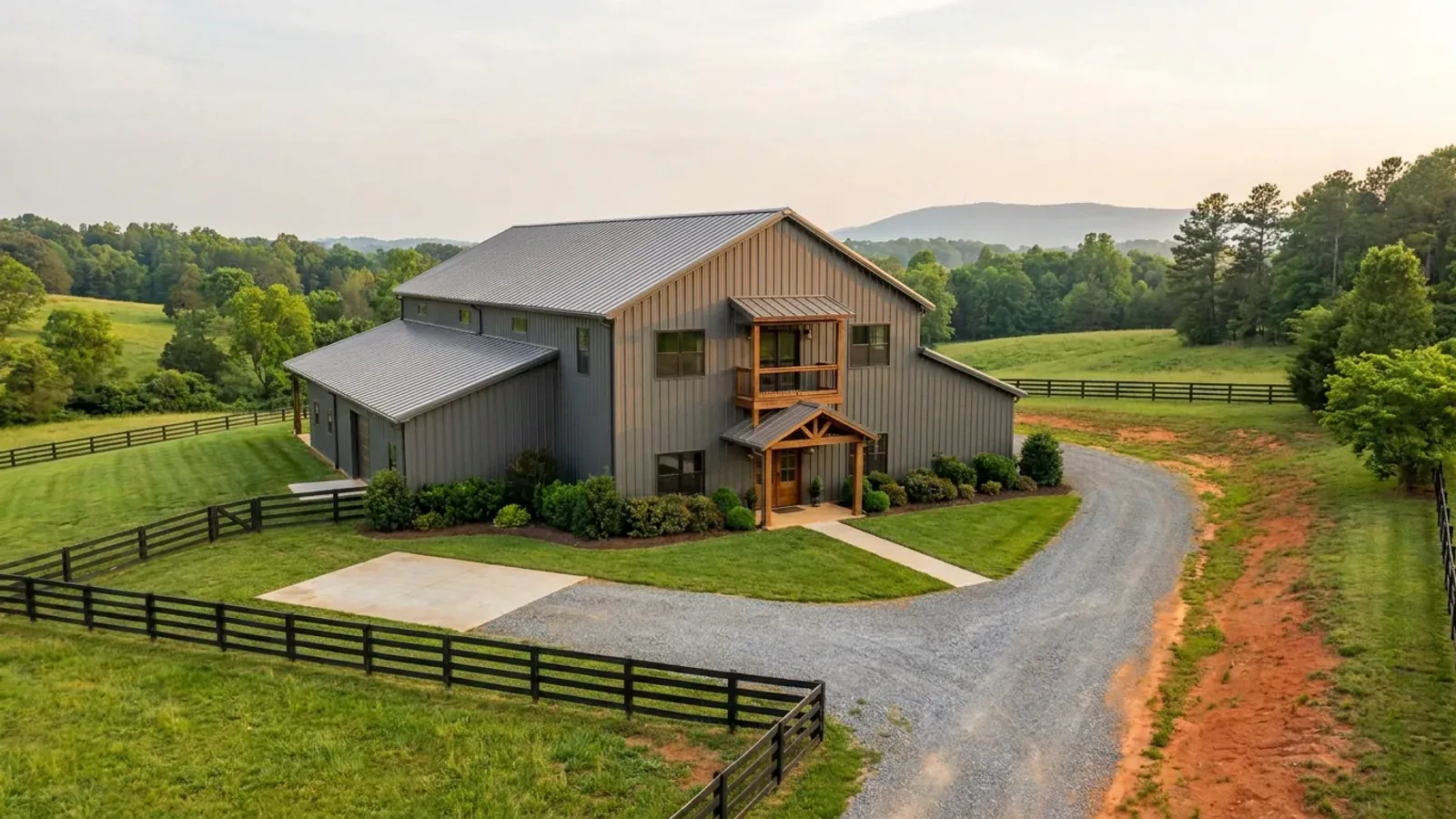
4-Bedroom Barndominium in Virginia
Nothing about a four-bedroom barndominium is difficult except the ground. The building is permitted as a single-family detached dwelling like any other, on the same statewide code; what changes is the septic arithmetic, and it changes by exactly one step. 12VAC5-610-670 Table 5.1 designs a dwelling at 75 gallons per day per person and its footnote 1 fixes two persons per bedroom, so four bedrooms is 600 gallons per day against three bedrooms' 450. Fauquier County's ordinance prints the four-bedroom case as its own worked example when sizing a pump chamber: "4 bedrooms x 150 gals/day/bedroom x 2 days = 1,200 gals." Those extra 150 gallons per day then get multiplied by the soil. 12VAC5-610-950 D 1 converts gallons to trench bottom by log y = 2.00 + 0.008x, so the fourth bedroom costs about 200 additional square feet of field on Group I sand and about 800 at the 91 minute-per-inch rate 12VAC5-610-490 assigns to clay — before any reserve is added. Where a locality demands a 100 or 200 percent reserve, that single bedroom can require two to three thousand square feet of additional proven, unbuildable soil. That is why the four-bedroom question is really a land question, and why it is worth answering before an offer goes in.
What actually changes with this feature
The look is the easy part. These are the decisions that follow from it.
600 gallons per day, and a county that prints the sum
12VAC5-610-670 Table 5.1 designs a dwelling at 75 gallons per day per person, footnote 1 fixing two persons per bedroom — 600 gpd at four bedrooms. Fauquier's ordinance uses the four-bedroom case as its own worked example at § 17-7(a)(12), sizing a pump system for two days of flow: "4 bedrooms x 150 gals/day/bedroom x 2 days = 1,200 gals." Nothing else in the building moves the number. There is no living-area band in Table 5.1's dwelling row and no row anywhere in the table for a shop, garage or barn, so a 5,000 sq ft shop bay is still 600 gpd.
The ground that makes four bedrooms hard, measured rather than assumed
Natural Resources Conservation Service septic-absorption ratings, county by county, do not flatter Virginia. New Kent County: not one acre rates "Not limited", 99,001 acres rate "Very limited", and the leading limitation is groundwater near the surface across 75,732 acres — not clay, not slope. Prince William County: zero acres "Not limited" again, 142,398 "Very limited", led by shallow bedrock at 70,528 acres and a high water table at 69,684. Pittsylvania County: 427,913 of 654,200 acres "Very limited", zero "Not limited", driven by seepage at 267,412 acres and slope at 149,154 — again not tight clay.
Reserve area, which multiplies the difference
12VAC5-610-710 requires a separate reserve equal to 50 percent of the required absorption area wherever the percolation rate exceeds 45 minutes per inch, and 12VAC5-610-500 requires sufficient suitable soil for the system and the reserve both. Inside a Chesapeake Bay Preservation Act locality the reserve for new construction is 100 percent regardless of rate and cannot be built on — Va. Code § 62.1-44.15:68 is a closed statutory list of 29 counties and 17 cities. Fauquier is not on that list and asks for more: § 17-7(a)(11)b requires 200 percent outside a designated service district, all of it on the parcel it serves under § 17-7(a)(9).
The bedroom count is what gets permitted, so decide it once
The Virginia Department of Health issues the septic permit, not the private evaluator, with 15 working days on a single-lot permit before it is deemed approved under Va. Code § 32.1-163.5. Prince William's building-permit requirements state that adding a bedroom to a dwelling on a private well and septic system requires written approval of the Prince William Health District before a building permit issues. Franklin County's building FAQ puts a Department of Health construction permit first whenever a dwelling is built or bedrooms are added. Albemarle § 18-4.1(b)(2) sets a three-bedroom floor on every drainfield regardless — so the fourth bedroom is the first one a four-bedroom plan actually pays for there.
One bedroom, 150 gallons a day, and anywhere from 200 to 2,400 square feet of ground
Run the state's own equation. 12VAC5-610-950 D 1 gives log y = 2.00 + 0.008x for square feet of trench bottom per 100 gallons at percolation rate x. On Texture Group I sand at 16 minutes per inch, three bedrooms needs about 600 square feet of trench and four needs about 800 — a 200 square foot step, with no reserve required at all because 16 is well under the 45 minute-per-inch trigger in 12VAC5-610-710. At the 91 minute-per-inch rate 12VAC5-610-490 assigns to Texture Group IV clay, three bedrooms needs about 2,400 square feet and four about 3,200 — an 800 square foot step, now carrying a mandatory 50 percent reserve. In rural Fauquier, where § 17-7(a)(11)b requires a 200 percent reserve outside a designated service district, that same 800 square feet of primary field brings 1,600 square feet of reserve with it: roughly 2,400 square feet of additional proven ground for one bedroom. And at 120 minutes per inch there is no conventional trench at all — 12VAC5-610-950 B bars it, and Fauquier § 17-7(a)(4) writes the same wall into county law.
Common ways to build this
Common configurations we see. Yours does not have to match one exactly — this is a starting point for the conversation, not a catalog.
Four bedrooms on fast soil
600 gpd design flow / roughly 800 sq ft of trench / no reserve required
The easy case, and it is worth naming because it exists. On Texture Group I sand or loamy sand, assigned a design rate up to 16 minutes per inch by 12VAC5-610-490, 12VAC5-610-950 D 1 returns about 134 square feet of trench bottom per 100 gallons — roughly 800 square feet at 600 gallons per day. That rate is far below the 45 minute-per-inch threshold in 12VAC5-610-710, so no reserve is required on soil grounds at all. The whole difference between the third and fourth bedroom here is about 200 square feet of field.
Four bedrooms on Texture Group IV clay
600 gpd / roughly 3,200 sq ft of trench / 50 percent reserve mandatory
12VAC5-610-490 places sandy clay, silty clay and clay in Texture Group IV at 91 minutes per inch or more. At 91 the equation returns about 535 square feet of trench bottom per 100 gallons — roughly 3,200 square feet at 600 gallons per day, plus a mandatory 50 percent reserve on top because the rate is past 45. 12VAC5-610-490 F adds a practical warning worth knowing before a test is scheduled: shrink-swell soils "may exhibit satisfactory percolation rates when dry and therefore must be thoroughly wetted before a percolation test is performed." The same clay that puts an engineer on the foundation multiplies the field.
Four bedrooms in a Bay Act locality
600 gpd primary plus a 100 percent reserve that stays unbuilt
Va. Code § 62.1-44.15:68 names 29 counties and 17 cities, Arlington, Fairfax, Prince William, Henrico and the City of Richmond among them, and membership is statutory rather than geographic. Inside those localities the reserve drainfield for new construction is 100 percent of the primary field, applies whatever the percolation rate, and cannot be built on — so a four-bedroom design reserves as much ground again as it uses. New dwellings are barred from the Resource Protection Area except by narrow pre-1989 and pre-2002 lot-recordation routes and never into the seaward 50 feet. A locality off the list may still carry a buffer by another instrument: Rappahannock runs a Stream Protection Overlay Zone without being a Bay Act county.
Four bedrooms in rural Fauquier
600 gpd primary plus 200 percent reserve, all on the parcel
The strictest reserve found on this build, and it applies exactly where a barndominium buyer is looking. § 17-7(a)(11)b requires a reserve equal to 200 percent of the primary absorption area for a lot outside a designated service district; § 17-7(b)(5) allows a reduction to 100 percent only on an existing lot where the setbacks would otherwise preclude development. § 17-7(a)(9) puts both the installation area and the reserve entirely on the parcel they serve. On top of that, § 17-7(a)(3) sets a 600 square foot minimum trench bottom against the state's 400, § 17-7(a)(4) bars any field above 120 minutes per inch, and § 17-7(a)(7) keeps fields on slopes under 25 percent absent a joint determination by the health director and the county soil scientist.
Four bedrooms with a full shop bay
2,400 sq ft living, 4 bedrooms / 2,400 sq ft shop
The septic side is indifferent to the shop — Table 5.1 has no row for one — so the constraint moves to zoning. Chesterfield § 19.2-32-1 B allows accessory buildings in RC up to 200 percent of the dwelling's gross floor area and § 19.2-32-1 C caps them at 100 percent in SR, SC, SU and AR, both of which a four-bedroom dwelling clears comfortably where a small one would not. Isle of Wight Sec. 5-2000.A.1 caps an accessory building at the primary structure's square footage; Goochland § 15-285.B sets no cap at all; Rockingham § 17-805(a) allows an accessory structure taller than the house in A-1, A-2 and RV only.
Ways to build this size
A footprint can go together several ways. These are the service lines most relevant to it.
Custom Plans
Barndominium floor plans drawn to your parcel and to the design criteria your own Virginia locality publishes, not to a generic national spec.
Read moreTurnkey Builds
Start to finish barndominium construction: permits, site work, shell and full interior finish, under one contract and one schedule.
Read moreSite Preparation
Clearing, grading, pad, drainage and utilities, plus the septic work that has to clear before any building permit can issue.
Read morePost-Frame Homes
Post-frame construction built as a dwelling under the Virginia code, with wide clear spans and a straight answer on the farm-building exemption.
Read more4-Bedroom Barndominium: common questions
7 questions we get asked most often about this footprint. If yours is not on the list, ask it directly.
How much bigger is the septic system for four bedrooms than for three?
Is there a point where a four-bedroom simply will not fit a parcel?
Does the shop, garage or barn add to the four-bedroom sizing?
Which parts of Virginia make a four-bedroom drainfield hardest?
How much reserve drainfield does a four-bedroom need?
Can I permit three bedrooms now and add the fourth later?
Does a four-bedroom barndominium need anything different structurally?
Keep reading
The pages that answer the next question this one raises.
Fauquier County
The 200 percent reserve outside a service district, a 600 sq ft minimum trench bottom, and the ordinance that prints the four-bedroom sum.
Read itNew Kent County
Not one acre rates "Not limited" for a septic absorption field, with groundwater near the surface across 75,732 acres.
Read itPittsylvania County
427,913 of 654,200 acres "Very limited", and the limitation is seepage and slope rather than clay.
Read itWant this drawn for your program and your parcel? That is where a build actually starts.
Start your plans
Tell us what you want to build and we will draw this for your program, then confirm what it looks like on your parcel, the wind load it has to meet, and a realistic budget range. That conversation costs nothing.