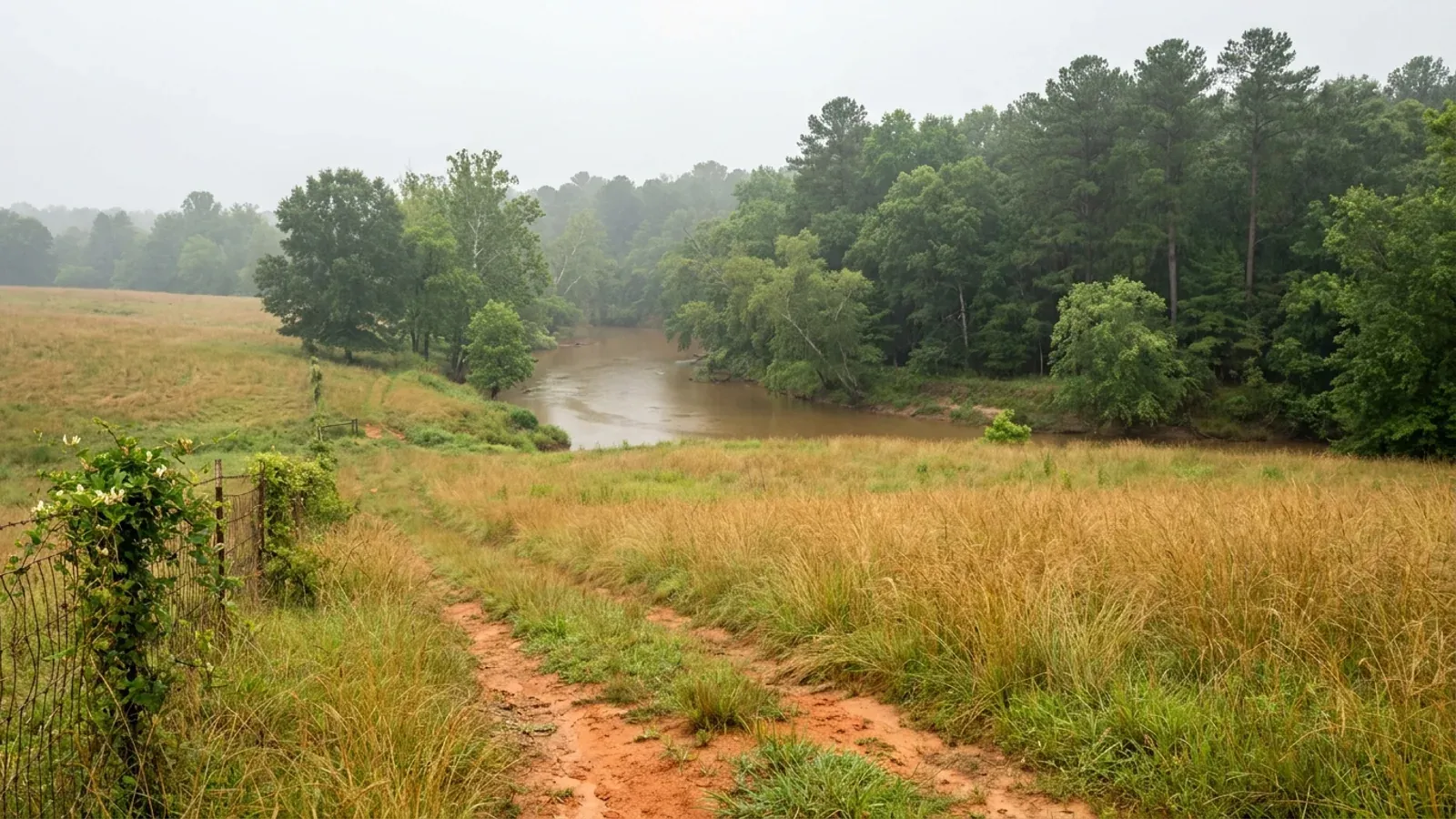
Rolling farmland and mixed hardwood west of Richmond with red clay soil and a wooded creek bottom.
Petersburg One statewide code, no local amendments

Barndominium Builders in Petersburg, VA

Petersburg is one of Virginia's 38 independent cities, which means it belongs to no county at all: neither Dinwiddie nor Prince George has a building official or a zoning ordinance that reaches inside the city line, and the City's own Building Code Compliance Division at 1340 E. Washington Street issues every permit. It is also a small, dense, historic city of 22.7 square miles, and it has two rules that decide a barndominium before anything else does. The zoning ordinance prohibits corrugated sheet metal panels as a finish material anywhere in the city, and Petersburg is named in Va. Code § 62.1-44.15:68 as a Chesapeake Bay Preservation Act locality, which puts a hundred-foot buffer along both sides of any perennial stream and a full-size reserve drainfield behind every new house on septic. There is very little land here to build on, and cheap vacant property inside the city is vacant houses rather than buildable acreage. The land is in Dinwiddie and Prince George at the fence line, and in Amelia and Sussex beyond them.

Petersburg at a glance

Independent city
Petersburg
Population
33,734
ZIP codes
23803, 23805

Building conditions in Petersburg

The building code itself is the same in every Virginia locality, and no county, city or town may amend it. What changes from one to the next is who issues the permit and inspects the work, what that office charges, how the parcel is zoned, and the Table R301.2 design criteria the locality publishes — the 2021 Virginia Residential Code prints that table blank, with the instruction that additional criteria shall be established by the local jurisdiction. Those local numbers are what your drawings have to satisfy.

Build conditions for Petersburg , Virginia : design wind speed 115 mph. BUILD CONDITIONS PETERSBURG, VAPetersburgONE STATEWIDE CODEDESIGN WIND SPEED115 mphThe City's own Local Design Criteria sheet, published by the Building Code Compliance Division,prints 115 under "Wind Speed MPH V3S" for 1 and 2 family residential construction, and its…ZONING · "A" AGRICULTURAL DISTRICT (ZONING OR…R-1A: 15,000 sq ft and 100 ft of wid…Article 22's height, area and bulk chart carries every district. In"A" Agricultural a single-family dwelling is permitted by right at…PERMIT FEES CHARGED AS A PERCENTAGE OF CONSTR…0.625% + $25 building; 1% + $25 each…Not an impact fee — Petersburg levies none. Its published permit feeschedule prices 1 and 2 family residential work as a share of…WHO ISSUES THE PERMITCity of Petersburg — Neighborhood Se…1340 E. Washington Street, Petersburg. Permits, plan review andinspections. Plan review is circulated to Building Inspections,…
Build conditions for Petersburg, drawn from the sourced facts on this page. Every figure above is cited in the quick-facts panel below, with its source and vintage.
It is in no county at all
Petersburg is one of Virginia's 38 independent cities — a county equivalent that belongs to no county. Dinwiddie County wraps it to the west and south and Prince George County adjoins it to the east, and neither has a building official or a zoning ordinance that reaches inside the city line. The City's Building Code Compliance Division at 1340 E. Washington Street issues the permit and inspects the work. Most general advice about Virginia says permits are handled at the county level; for Petersburg, and for every one of Virginia's eight largest places, that is simply wrong. The code being enforced is the same code enforced everywhere in the Commonwealth — the city's own page for it is titled "Codes Adopted by the Commonwealth", and City Code § 22-31 provides that future amendments to the statewide code are automatically adopted into City Code.

Code of the City of Petersburg, Ch. 22 Art. II §§ 22-31 and 22-33 (Ord. No. 07-53, 6-19-2007; Ord. No. 19-56, 12-10-2019), via api.municode.com jobId 495653; City of Petersburg, Code Enforcement, "Codes Adopted by the Commonwealth", petersburgva.gov/765 (read 2 Sep 2026); Va. Code § 36-98, § 36-105(A)

Corrugated sheet metal is prohibited as a finish material
Zoning Ordinance Article 25 § 4.4(2): "Corrugated sheet metal panels used as a finish material are prohibited. Architectural metal panels may be accepted, subject to consultation with and a determination by the director of planning and community development that the treatment meets the intent of this section." Article 25 supplements the regulations of every district, so this applies across the whole city, and it was added by zoning text amendment 24-ZTA-04 adopted on 18 June 2024. Article 25 § 4.1 adds that before a building permit is issued for a new dwelling the applicant must submit an architectural theme for approval, describing exterior materials, colours, style and building scale. The commonest barndominium exterior in the country is the one Petersburg names and bars. An architectural metal panel system is still open, but as a discretionary determination rather than a by-right choice, so the exterior specification has to be settled with Planning and Community Development before a permit application makes sense.

Code of the City of Petersburg, App. B Zoning, Art. 25 §§ 4.1 and 4.4 (Ord. No. 24-ZTA-04, 6-18-2024), read via api.municode.com CodesContent, jobId 495653, productId 11423 (2 Sep 2026)

Cheap property here is vacant houses, not buildable land
Petersburg's own comprehensive plan, PetersburgNEXT, adopted 21 May 2024, records 18 percent of housing units vacant against 82 percent occupied — "more than double the statewide average" — with 3,238 vacant units of which 1,936, nearly 60 percent, fall in the "other vacant" category the plan reads as indicating "a high percentage of uninhabitable houses". Median household income is $46,930 against $87,249 statewide and 22.2 percent of residents are below the federal poverty line, against 11 percent in Dinwiddie and 8.3 percent in Prince George. That combination genuinely does put inexpensive property on the market inside the city. What it does not put on the market is acreage: those are lots in a street grid with houses on them or houses recently gone from them, sized for the housing stock that stood there. A shop with living quarters needs land, setbacks and, off public sewer, room for two drainfields.

City of Petersburg, PetersburgNEXT Comprehensive Plan, adopted 21 May 2024 — housing and vacancy infographics (2016-2021 ACS 5-Year Estimates), Regional Health Data table (2018-2022 ACS 5-Year Estimates; 2023 County Health Rankings), petersburgva.gov/DocumentCenter/View/8262 (read 2 Sep 2026)

The largest residential lot minimum in the city is a third of an acre
Article 22 of the Zoning Ordinance sets the minimum lot area for R-1A, the most spacious single-family district Petersburg has, at 15,000 square feet with 100 feet of width. R-1 is 8,000 square feet, R-2 and the mobile home district 5,000. The city does have an "A" Agricultural district, and a single-family dwelling is permitted there by right at up to 45 feet in height, but land only qualifies for it inside a minimum contiguous area of eight acres all zoned agricultural, rezoning is a $1,500 application, and the plan notes agricultural land use in the city is "limited and non-intensive", found in the south-west along Flank Road and Johnson Road. Under Article 3 a dwelling is "any building, or portion thereof, designed or used for residential purposes", so a shop and living quarters under one roof reads as a dwelling; the moment the shop is a separate structure it becomes an accessory building and picks up a much tighter rule set.

Code of the City of Petersburg, App. B Zoning, Art. 3 (definitions), Art. 4-A and Art. 22 height, area and bulk chart, via api.municode.com jobId 495653; City of Petersburg Planning and Community Development, Fees Table updated 28 Aug 2024, petersburgva.gov/2227 (read 2 Sep 2026); PetersburgNEXT Comprehensive Plan, Existing Land Use

Petersburg is on the Chesapeake Bay Act list — Dinwiddie is not
Va. Code § 62.1-44.15:68 names the jurisdictions that make up "Tidewater Virginia" and Petersburg is one of the seventeen cities on it, alongside Colonial Heights, Hopewell and Richmond, and alongside Prince George among the twenty-nine counties. Dinwiddie, Amelia and Sussex are not on it. The list is statutory and closed, and it is not a matter of being near the coast — the Act reaches inland up the tidal rivers, and Petersburg's own plan records tidal wetlands on the Appomattox River and Poor Creek. Inside the city that means a 100-foot vegetated buffer along both sides of any water body with perennial flow, a full-size reserve drainfield behind every new house on septic with building prohibited on it, a five-year septic pump-out, and a plan-of-development review triggered at 2,500 square feet of land disturbance rather than an acre. Cross the line west or south into Dinwiddie and none of that follows you. Cross east into Prince George and all of it does.

Va. Code § 62.1-44.15:68, law.lis.virginia.gov/vacode/title62.1/chapter3.1/section62.1-44.15:68/ (served text read 2 Sep 2026); Code of the City of Petersburg, Ch. 122 Art. II §§ 122-51, 122-77 and 122-78, via api.municode.com jobId 495653; PetersburgNEXT Comprehensive Plan, ch. 8

Where the land actually is, county by county
Dinwiddie County wraps Petersburg west and south and is the volume answer: 101,333 acres in farms, 31.4 percent of the county, a median farm of 79 acres and 130 operations under 50 acres, which is the deepest supply of small buildable tracts within a few minutes of the city line — and it is not a Chesapeake Bay Act locality. Prince George County adjoins on the east and has the smallest parcels of the four at a 37-acre median, but only 13.7 percent of its land is in farms and it is the most suburban at 166 people per square mile; it is on the Bay Act list, so the buffer and reserve-drainfield rules travel with you. Amelia County, further west, runs 38 people per square mile with 27.4 percent of its land in farms and 95 operations under 50 acres. Sussex County to the south is the emptiest at 22 people per square mile and the only one of the four losing population, but read its farm structure before assuming it is the easy option: 106 farms averaging 656 acres, a median of 225 acres, and just fourteen operations under 50 acres in the whole county. Sussex is large-tract country.

2022 Census of Agriculture, county acreage and farm-size series, and 2020-2025 population estimates, both via research/statewide/geography-and-population.md; Va. Code § 62.1-44.15:68 for Bay Act membership

Also worth knowing before you build in Petersburg

A detached shop over 1,000 square feet goes to Council
Zoning Ordinance Article 4-A § 2(2) permits accessory buildings for residential purposes in the "A" Agricultural district in rear yards only, no closer than five feet to any party lot line, at no more than 30 percent of the area of the rear yard, and with the workshop use expressly not "conducted for gain". Then the clause that decides a barndominium: "any accessory building to be erected containing an area in excess of one thousand (1,000) square feet shall be referred to the city planning commission, which commission shall make its recommendations to the council", after a noticed public hearing before the commission and a second before council. A separate shop building is therefore a legislative decision in the A district, not a counter transaction, and the same section was last amended on 16 September 2025. Combining the shop and the living space into one structure changes the classification: under Article 3 that is a dwelling, and a dwelling is a by-right use.

Code of the City of Petersburg, App. B Zoning, Art. 4-A §§ 2, 5, 6, 7 and 9 (Ord. No. 2025-057, Exh. B, 9-16-2025; Ord. No. 23-14, Exh. A, 3-21-2023), read via api.municode.com CodesContent, jobId 495653 (2 Sep 2026)

The permit fee is a percentage, and it is reconciled at occupancy
Petersburg's published fee schedule prices 1 and 2 family residential building permits at five-eighths of one percent of estimated construction cost plus a $25 base fee, and prices electrical, mechanical and plumbing permits at one percent plus $25 each — so a build pulling all four pays 3.625 percent of estimated cost plus $100, with a 2 percent state levy added to the total and remitted quarterly to the state housing department under City Code § 22-61(b). Starting work without a permit is $50, and a re-inspection caused by the permit holder is $50. City Code § 22-62 then requires the owner to report the final total cost of construction — labour, material, equipment, profit and incidental expenses, excluding design services not in the construction contract — before the certificate of occupancy is issued. The estimate on the application is not the end of the arithmetic.

City of Petersburg, Code Enforcement, Permit Fee Schedule, petersburgva.gov/368 (read 2 Sep 2026); Code of the City of Petersburg, Ch. 22 Art. II §§ 22-36, 22-61 and 22-62, via api.municode.com jobId 495653; Va. Code § 36-137

The city adds its own contractor requirements on top of the state's
City Code § 22-102 requires every contractor, builder or subcontractor who contracts for construction work in Petersburg to register annually with the building code official, renewed by 30 June each year and not renewable until all city business licence fees for that year are paid. Section 22-104 requires proof of state board licensure and of a business licence, with a city business licence required once revenue for work inside the city passes $15,000 in a calendar year. Section 22-106 requires anyone holding a Class C or Class B contractor's licence to give a $5,000 bond approved by the city attorney; Class A holders are exempt. A homeowner doing the work themselves signs an owner-builder affidavit under § 22-101, which states plainly that it does not exempt them from obtaining a permit, having the work inspected, or paying the fees.

Code of the City of Petersburg, Ch. 22 Art. III §§ 22-101, 22-102, 22-103, 22-104 and 22-106 (Ord. No. 07-53, 6-19-2007; Ord. No. 19-56, 12-10-2019), read via api.municode.com CodesContent, jobId 495653 (2 Sep 2026); Va. Code §§ 54.1-1100 and 54.1-1101

One corner of buffer pulls in the whole parcel
Petersburg's Chesapeake Bay Preservation Area ordinance sits in Chapter 122 of the City Code, under Waterways rather than under zoning or environment. Section 122-51(c) is the clause that surprises buyers: "If the boundaries of a resource preservation area (RPA) or resource management area (RMA) include a portion of a lot or parcel, the entire lot or parcel shall comply with the requirements of the overlay district. The division of property shall not constitute an exemption from this requirement." Section 122-53 adds that any lot must have sufficient area outside the RPA to accommodate the intended development. A new dwelling is not among the uses § 122-54 allows in an RPA at all; the only ways in are the administrative encroachment for a lot recorded before 1 October 1989, which can never reach into the seaward 50 feet of the buffer, and the narrower route for a lot recorded between 1 October 1989 and 1 March 2002. Section 122-77(b)(1) also requires existing trees six inches or more in diameter at breast height to be preserved outside the construction footprint, with protective fencing five feet beyond the dripline for the whole build.

Code of the City of Petersburg, Ch. 122 Art. II §§ 122-51, 122-53, 122-54, 122-77 and 122-78 (Code 1981 § 9.5-5; Ord. No. 04-51, 6-15-2004; Ord. No. 21-16, Exh. A, 3-23-2021; Ord. No. 22-3, 1-18-2022), read via api.municode.com CodesContent, jobId 495653 (2 Sep 2026); 9VAC25-830-80, -130, -140

The soil survey under Petersburg is Dinwiddie's
Petersburg has no soil survey area of its own. The Natural Resources Conservation Service maps the city inside survey area VA653, "Dinwiddie County Area, Virginia", so the measured soil picture for the city and for the county it sends people to is one dataset of 344,400 acres. Rated for septic tank absorption fields, about 150,700 of those acres rate Very limited and roughly 142,100 Somewhat limited, while only about 3,300 acres — near one percent of the rated area — rate Not limited. The dominant limitation is not slope: it is the percolation behaviour of the 24 to 72 inch layer, which limits 291,793 acres, followed by a seasonal water table near the surface on 124,005 acres. Slope is third at 70,168 acres. Shrink-swell clay is real here but confined: 12,645 acres, 3.7 percent of the survey area, carry a horizon at linear extensibility of 6 percent or more, and almost all of it is two series — Iredell across 7,024 acres, reaching a linear extensibility of 17, and Helena across 5,622. Those are survey-area figures, not a statement about any particular parcel.

USDA NRCS Soil Data Access, SDMDataAccess.sc.egov.usda.gov/Tabular/post.rest — legend, laoverlap, mapunit, component, chorizon and cointerp tables for areasymbol VA653, rule "ENG - Septic Tank Absorption Fields" (queried 2 Sep 2026)

Septic here is a Crater Health District permit, sized per bedroom
The Virginia Department of Health issues the onsite sewage system permit, not a private evaluator, and for Petersburg that is the Crater Health District — which also runs the Dinwiddie, Prince George and Sussex health departments, so three of the four counties this page points to share the same office. The state sizes a system at 150 gallons per day per bedroom under 12VAC5-610-670 Table 5.1, with no band for living area and no row for a shop, garage or barn at all: the bedroom count drives the drainfield and the square footage of workshop does not. Soil texture assigns the design percolation rate under 12VAC5-610-490 rather than it being assumed, and clay falls in Texture Group IV at 91 minutes per inch or slower, past the point at which a reserve drainfield is required. Inside Petersburg the Bay Act makes that reserve field a full-size one that must stay clear of buildings and impervious surface permanently.

Virginia Department of Health, Crater Health District, vdh.virginia.gov/crater/ (read 2 Sep 2026); Code of the City of Petersburg § 122-77(g) and (h), via api.municode.com jobId 495653; 12VAC5-610-670 Table 5.1; 12VAC5-610-490; Va. Code § 32.1-163.5
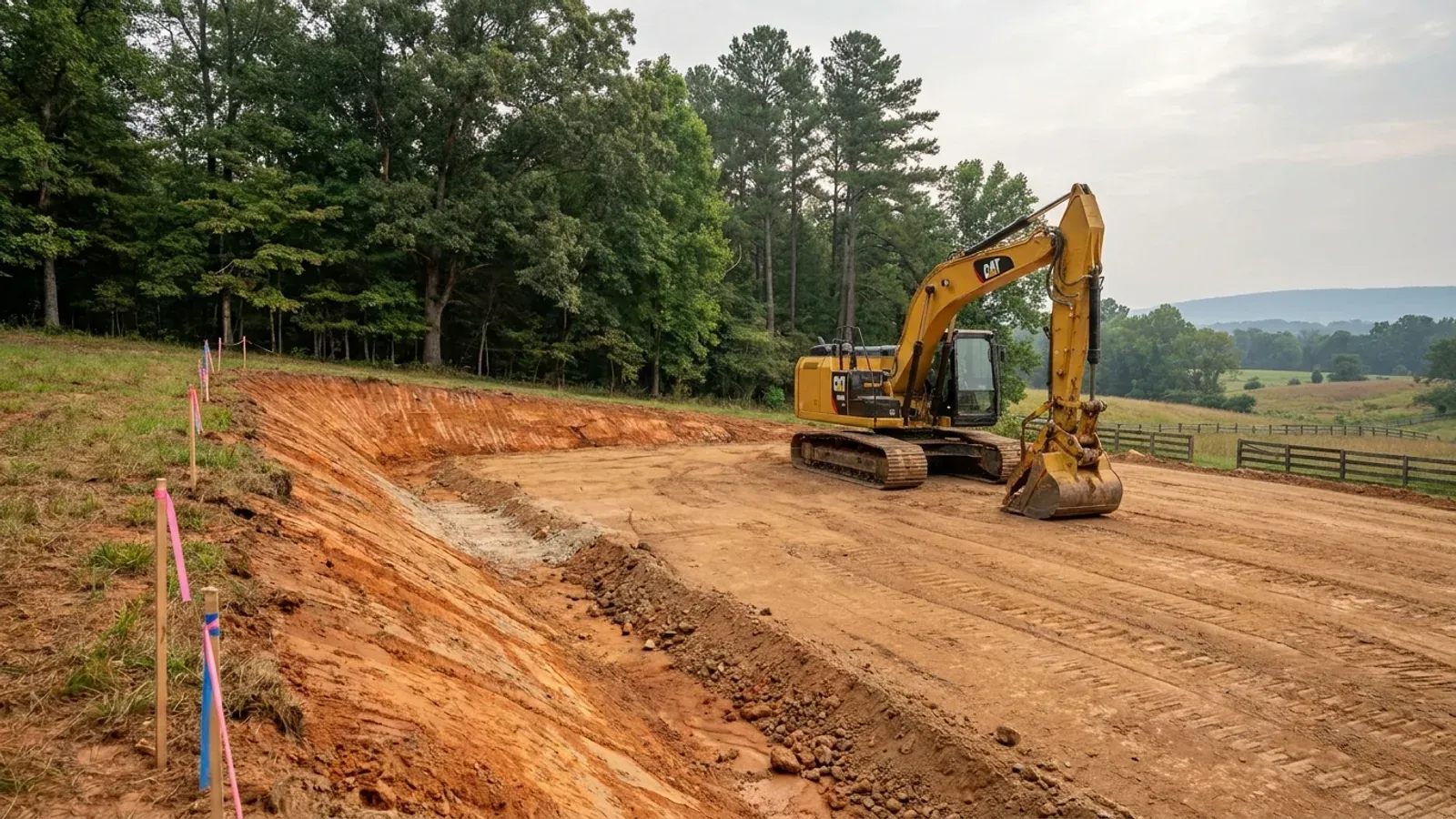
An excavator grading a compacted building pad on a cleared lot, with survey stakes and a drainage swale visible.
Below the slab

The expensive surprises are in the ground, not the building

What moves a Virginia budget is usually below grade, and it is soil rather than rock. Five localities already treat a soil answer as a condition of the permit rather than a recommendation — Fauquier, Chesterfield, Isle of Wight, Madison and Culpeper each require a soil report, an engineered foundation design, or both before the footings are approved. Chesterfield asks for one on every new house with no opt-out, on its own published reasoning that small amounts of shrink-swell soil may turn up anywhere in the county. Virginia Energy puts the same point bluntly: standard homeowner's insurance does not cover damage from expansive or compressive soils. Along the Interstate 81 corridor the question changes shape entirely — Virginia Energy counts twenty-seven Virginia counties in the karst zone that follows that road, where what matters is what is under the slab rather than what the slab sits in, and karst does not stay west of the Blue Ridge: Loudoun County publishes karst terrain of its own, on the other side of it. The same ground then sizes the septic system, because 12VAC5-610 works from bedrooms and soil texture — 150 gallons a day per bedroom, with no row in the table for a shop, a garage or a barn at all, and clay assigned to the slowest texture group at 91 minutes per inch or worse, past the 45 minutes per inch that makes a reserve drainfield mandatory. The soil that needs a foundation engineer multiplies the drainfield. So the site work, the foundation and the drainfield get resolved together rather than one at a time. We price the dirt before we price the building.

What a build looks like

Three stages every Petersburg project passes through, from a raw parcel to a finished home. Site work first, because that is where the budget is decided.
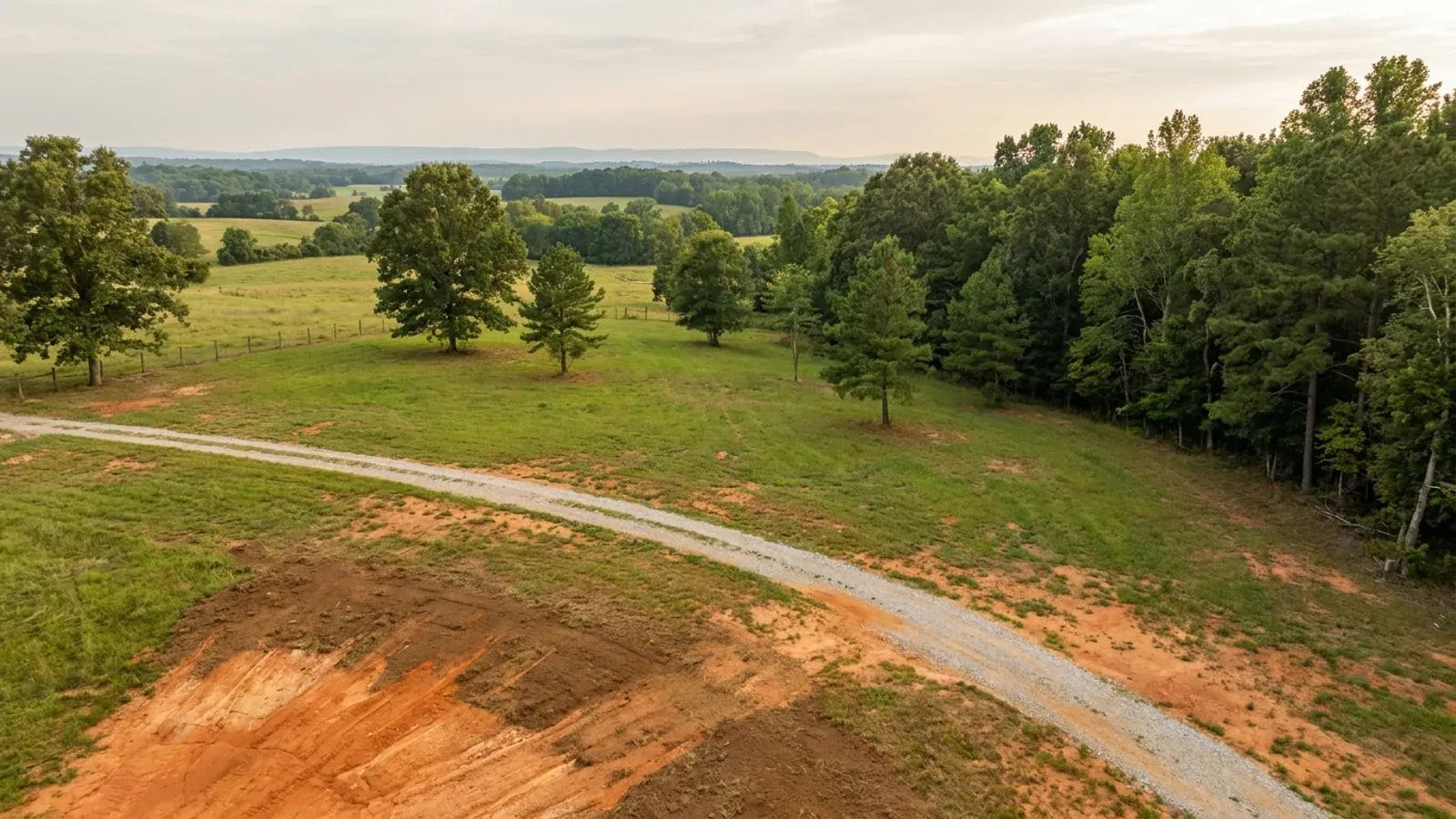
Aerial view of an undeveloped rural lot with cleared grass, a oak and hickory treeline with a few loblolly pines, and a pale gravel access track.
Stage one

The parcel

Zoning, setbacks, flood zone and utility access get checked before anything is drawn.

An excavator grading a compacted building pad on a cleared lot, with survey stakes and a drainage swale visible.
Stage two

Pad and permit

Clearing, grading and a compacted pad, while the submittal works through whichever office issues the permit where you are building.
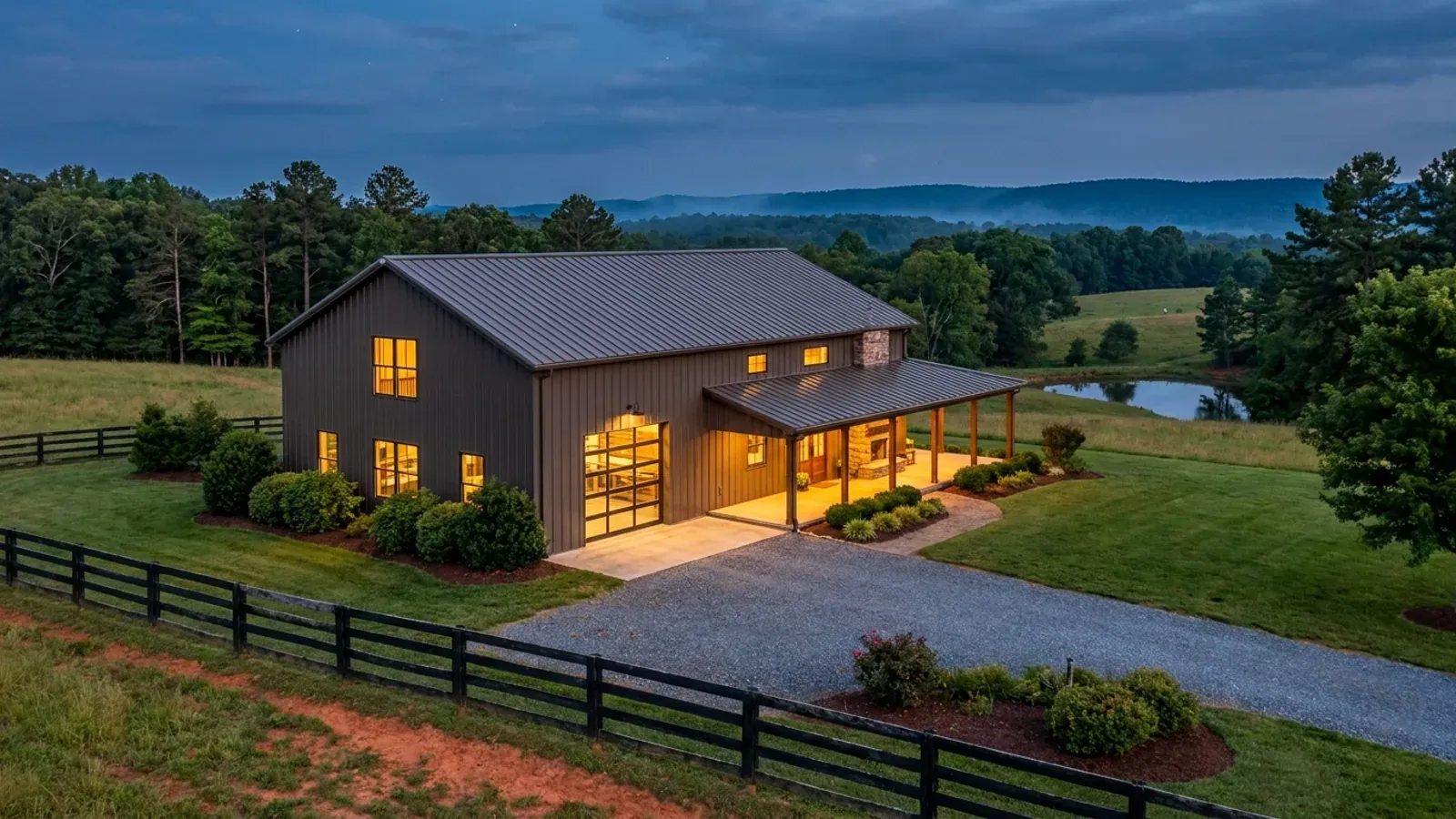
A finished barndominium at dusk with warm interior lighting glowing through its large windows.
Stage three

Frame to finish

Shell erected and dried in, then systems, insulation and interior finish through to CO.

Those are the rules where you are building in Petersburg. Tell us what you want to build and we will draw it to them.

Where we build around Petersburg

Petersburg and the rural land around it. The buildable acreage for a project this size usually sits outside the city limits, which is frequently what changes who issues your permit.

The Petersburg service area, including the rural acreage outside the built-up edge, which is where the parcels big enough for a build like this usually sit. The map marks the territory we build in. It is not a branch location, and there is no office at this pin.

Nearby areas we build in

Others we cover nearby. One may be a county, another an independent city that belongs to no county at all, and another a town inside a county — so the office that issues the permit, the fees it charges, the zoning and the design criteria each locality publishes can all differ from one card to the next.

Building in Petersburg: common questions

7 questions we get asked most often about building in Petersburg. If yours is not on the list, ask it directly.

Who issues the building permit for a barndominium in Petersburg?
The City does, through the Building Code Compliance Division of Neighborhood Services at 1340 E. Washington Street. Petersburg is an independent city — one of 38 in Virginia — which makes it a county equivalent belonging to no county at all. Dinwiddie County wraps it to the west and south and Prince George County adjoins it to the east, and neither of them has a building official or a zoning ordinance with any force inside the city line. There is no county tier above the city to appeal to or apply to. A great deal of general advice about Virginia says permits are handled at the county level; here it is wrong. What is not local is the code itself: the Uniform Statewide Building Code supersedes local building codes across the Commonwealth and no locality may amend it, which is why the city's own page on the subject is titled "Codes Adopted by the Commonwealth". Zoning is a separate office in a separate building — Planning and Community Development at City Hall, 135 N. Union Street — and on a barndominium that office is the one you need first.
Can I build a metal-clad barndominium inside the City of Petersburg?
Not in the usual finish. Article 25 § 4.4(2) of the zoning ordinance states that corrugated sheet metal panels used as a finish material are prohibited, and Article 25 supplements the regulations of every district in the city, so there is no district where that changes. The same clause leaves a door open: architectural metal panels may be accepted, subject to consultation with and a determination by the director of planning and community development that the treatment meets the intent of the section. So the answer is a metal building in Petersburg needs an architectural panel system approved in advance, not an agricultural corrugated profile. There is a second step in the same article: § 4.1 requires that before a building permit is issued for a new dwelling, the applicant submit for approval documents defining the overall architectural theme — exterior materials, colours, style and building scale. Both provisions came in through zoning text amendment 24-ZTA-04, adopted 18 June 2024. Settle the exterior with Planning and Community Development before you order anything.
There's cheap vacant land in Petersburg. Can I put a shop and a house on it?
Almost certainly not, and the distinction matters more here than anywhere else in the Richmond market. Petersburg's vacancy is a vacancy of houses, not of land. The city's own comprehensive plan records 18 percent of housing units vacant, more than double the state rate, with nearly 60 percent of the 3,238 vacant units sitting in the category the plan itself reads as indicating uninhabitable houses. Those are lots in a street grid, sized for the housing that stood on them. The largest by-right residential minimum lot in the city is 15,000 square feet in R-1A — about a third of an acre — and R-1 and R-2 lots are 8,000 and 5,000 square feet. On a lot that size a shop with the doors and clear height a barndominium is built for does not fit behind a house within the setbacks, and if the parcel is off public sewer it also has to hold a well, a drainfield and, because Petersburg is a Chesapeake Bay Act locality, a second drainfield of equal size that must stay permanently clear of buildings. Inexpensive city property is real. Buildable acreage is a different thing, and it is outside the city line.
Does the Chesapeake Bay Preservation Act apply in Petersburg?
Yes. Va. Code § 62.1-44.15:68 lists the jurisdictions that make up Tidewater Virginia, and Petersburg is one of the seventeen cities named, along with Colonial Heights, Hopewell and Richmond. It is a closed statutory list rather than a question of proximity to the coast, and it reaches inland up the tidal rivers; Petersburg's own plan records tidal wetlands on the Appomattox River and on Poor Creek. The practical effects on a build are specific. A 100-foot vegetated buffer runs along both sides of any water body with perennial flow, and a new dwelling is not one of the uses permitted inside a Resource Protection Area — the only routes in are the administrative encroachment for lots recorded before 1 October 1989, which can never reach into the seaward 50 feet, and a narrower route for lots recorded between 1 October 1989 and 1 March 2002. If any part of a parcel falls in the RPA or RMA, City Code § 122-51(c) pulls the whole parcel into the overlay and says expressly that dividing the property does not get you out of it. Land disturbance over 2,500 square feet, which includes the house, the septic tank and the drainfield, triggers a plan-of-development review and the erosion and sediment control ordinance. New construction on septic needs a reserve drainfield equal to the primary and nothing may be built on it, and the system must be pumped out every five years. Environmental Engineering reviews for the Bay Act on every permit application as a matter of course.
What design numbers does Petersburg publish for a house?
The 2021 Virginia Residential Code prints Table R301.2 blank, with em-dashes in every cell and the instruction that additional criteria are to be established by the local jurisdiction — so the design numbers on your drawings are set by the locality, not the state, and they vary widely across Virginia. Petersburg publishes its own sheet through the Building Code Compliance Division. For 1 and 2 family residential construction it gives a ground snow load of 20 psf, a wind speed of 115 mph, seismic design category B, Moderate to Severe weathering, an 18-inch frost depth, Moderate termite probability and ice shield required. Its Miscellaneous Data block adds ultimate wind speeds of 105 mph for Risk Category I, 115 mph for Risk Category II and residential and 120 mph for Risk Category III, a mean annual temperature of 59.4 °F, a winter design temperature of 17 °F and an air freezing index of 1500. Petersburg falls in climate zone 4A under the residential code's own county table. Two things worth noting: 115 mph is well below the figures the code's own definition uses for a wind-borne debris region, and the city publishes no wind-borne debris row, so nothing in its criteria calls for impact-rated glazing. And seismic category B sits below the level at which the residential code stops exempting a detached house from its seismic provisions.
What will the permit actually cost in Petersburg?
Petersburg is one of the Virginia localities that prices permits as a share of construction cost rather than by square foot or by flat band, so the figure scales with the build. Its published schedule sets a 1 and 2 family residential building permit at five-eighths of one percent of estimated cost plus a $25 base fee, and sets the electrical, mechanical and plumbing permits at one percent plus $25 each. A build that pulls all four therefore pays 3.625 percent of estimated construction cost plus $100 in base fees, with a 2 percent state levy added to the total — that levy is the statewide Building Code Academy charge under Va. Code § 36-137, which the city collects and remits quarterly. Starting work before the permit is issued adds $50, and a re-inspection caused by the permit holder is $50. One detail people miss: City Code § 22-62 requires the owner to report the final total cost of construction before the certificate of occupancy is issued, so the estimate given at application is reconciled at the end rather than simply accepted. Separately, on the planning side, a rezoning or a special use permit application is $1,500 and a variance or BZA appeal is $500. The city levies no impact fee.
So where should I be looking instead — Dinwiddie, Prince George, Amelia or Sussex?
It depends on what you are trading. Dinwiddie is the obvious first stop: it wraps Petersburg west and south, has 101,333 acres in farms across 31.4 percent of its land, a median farm of 79 acres and 130 operations under 50 acres, which is the best supply of small buildable tracts anywhere near the city — and it is not on the Chesapeake Bay Act list, so the buffer, the plan-of-development trigger at 2,500 square feet and the mandatory reserve drainfield fall away. It also shares Petersburg's soil survey and its health district, so the ground and the septic office are the ones already described. Prince George is closer still on the east and has the smallest parcels of the four at a 37-acre median, but only 13.7 percent of it is farmland, it is the most suburban of the four at 166 people per square mile, and it is on the Bay Act list, so all of the Bay Act rules travel with you across that line. Amelia is further west, genuinely rural at 38 people per square mile with 27.4 percent of its land in farms and 95 operations under 50 acres, and it is not a Bay Act locality — though it is outside the Crater Health District, so a different health office handles the septic permit. Sussex to the south is the emptiest at 22 people per square mile and the only one of the four losing population, which sounds like the easiest place to buy until you read the farm structure: 106 farms, averaging 656 acres, a 225-acre median, and only fourteen operations under 50 acres in the entire county. Sussex is large-tract country and a ten-acre parcel is genuinely scarce there. One more thing that changes at that line: Sussex is climate zone 3A where Petersburg and Dinwiddie are 4A, so the insulation and envelope requirements are not the same. Each of these counties writes its own zoning ordinance, fills in its own Table R301.2 and appoints its own building official, so confirm the district and the design criteria with the county before you commit to a parcel.

Building in Petersburg?

Start with the plan. Tell us what you want to build and we will draw it, then confirm which office issues the permit for your parcel, what it will let you put there, and what wind load it has to meet. That conversation costs nothing.