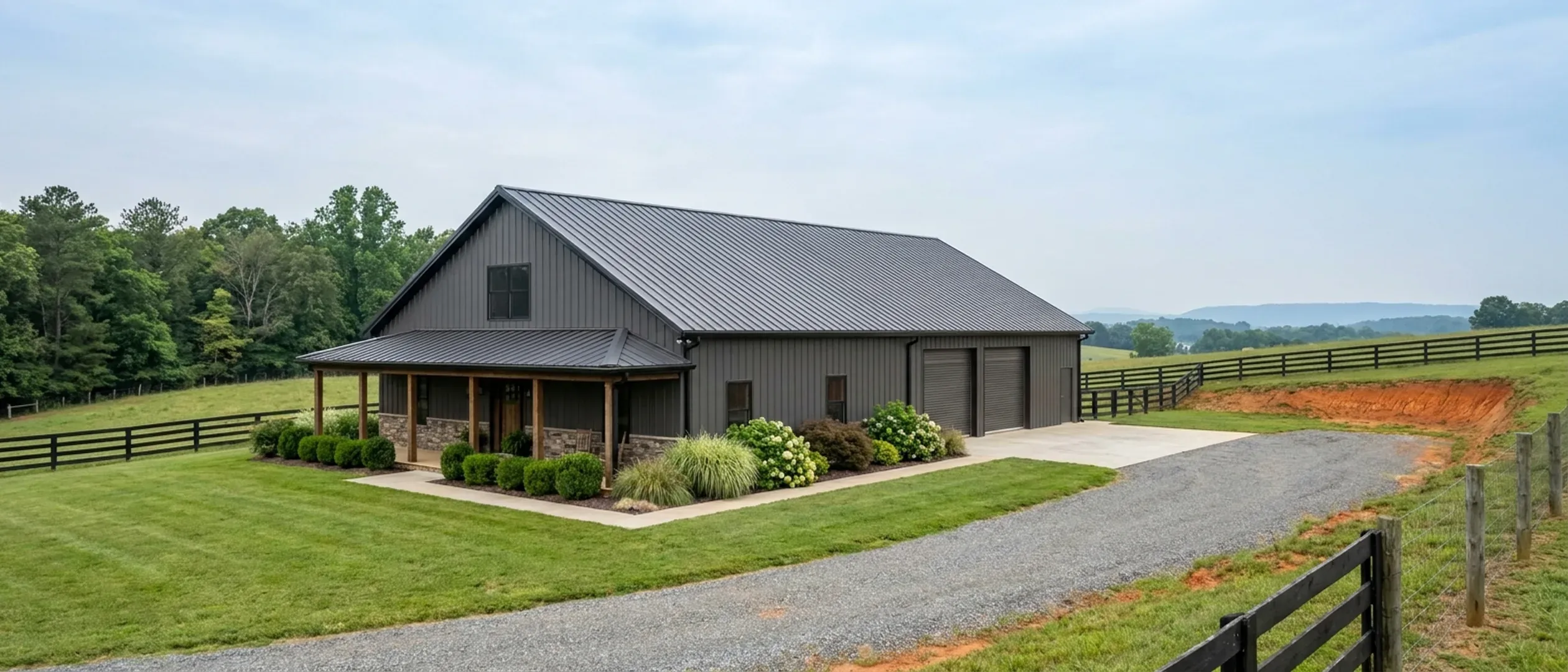
How Much Does a Barndominium Cost in Virginia?
Every page that answers this question with a confident dollar range is quoting a lead-generation marketplace. There is no federal survey of barndominiums, no Virginia agency that tracks them, and no representative sample of what they cost to build — because officially they are not a distinct building type at all. So this page does something different. It separates the two kinds of numbers that get mixed together: somebody's estimate of construction cost, which is soft everywhere, and a named Virginia locality's published fee, which is hard, checkable and startlingly variable. Arlington County publishes $1.70 per gross square foot for a new dwelling. Suffolk publishes $0.09. New Kent County does not price on floor area at all — it prices on market value. Those are not different prices for the same instrument; they are different instruments, and a reader comparing quotes across a county line is comparing things that do not compare.
Figures below are industry data from cited third-party sources, not a quote from Virginia Barndominium Builders. Every project is priced individually.
Bottom Line Up Front
- Nobody has measured what a barndominium costs to build. The U.S. Census Bureau's Survey of Construction has no barndominium category and no sampling frame for one, so every confident dollar-per-square-foot figure in circulation traces upstream to a lead-generation marketplace rather than to a survey.
- The one hard Virginia number is the permit fee, and it is not a single number. Arlington County publishes $1.70 per gross square foot for a new dwelling, Suffolk publishes $0.09, and New Kent County does not price on floor area at all — it prices on market value.
- Because localities meter on different instruments and stack their own surcharges on top, fee figures compared across a county line are not comparing the same thing. The 2% state levy is the only element that is identical everywhere.
Cost per square foot, by tier
The spread is wide because "barndominium" covers everything from a bare shell to a fully finished custom home. Tier is what actually explains the range, not location.
| Tier | Range | Source |
|---|---|---|
| Contractor-built house, median to average contract price per sq ft (South region, 2025 starts) | $157.3–$179.96 per sq ft | U.S. Census Bureau, Survey of Construction, 'Median and Average Contract Price per Square Foot of New Contractor-Built Single-Family Houses Started', 2025, South region. Published relative standard error 9% on the median, 8% on the average. Contract price excludes the land and excludes site work. |
| Contractor-built house, median contract price per sq ft across three years (South region, 2023-2025 starts) | $145.01–$157.3 per sq ft | U.S. Census Bureau, Survey of Construction, median contract price per square foot, contractor-built single-family houses started in the South region: 145.01 in 2023, 146.04 in 2024, 157.30 in 2025. A three-year span is more honest than any single sample year. |
Estimate a range for your square footage
Pick a size and a tier and this multiplies them against the same industry ranges printed in the table above, nothing new, nothing ours. It's a starting orientation, not a quote.
Estimated range
$0 – $0
This estimate comes from the industry cost data cited in the table above, not from Virginia Barndominium Builders. It doesn't account for your site, county, or finish choices, all of which move the real number. Send us the parcel for one that does.
Total cost by size
Rough totals at common sizes. These move with everything on this page, so treat them as a starting orientation, not an estimate for your project.
1,200 sq ft
$188,760–$215,952
The U.S. Census Bureau's 2025 median (157.30) and average (179.96) contract price per square foot for contractor-built houses started in the South region, applied to this floor area. Conventional houses, not barndominiums.
1,800 sq ft
$283,140–$323,928
Same Census Survey of Construction figures applied to 1,800 sq ft. Contract price excludes the land and excludes site work, so driveway, well and septic sit outside it.
2,400 sq ft
$377,520–$431,904
Same Census Survey of Construction figures applied to 2,400 sq ft. The Census publishes this series at the four-region level only, so 'South' means Virginia plus sixteen other states and the District of Columbia.
3,000 sq ft
$471,900–$539,880
Same Census Survey of Construction figures applied to 3,000 sq ft. The survey has no barndominium category, so no line in it describes this building type.
3,600 sq ft
$566,280–$647,856
Same Census Survey of Construction figures applied to 3,600 sq ft. The 2025 median carries a published relative standard error of 9% for the South region.
What actually moves the number
Which instrument your locality prices on
Most Virginia localities price a building permit on floor area. Some price it on value. New Kent County's Appendix A schedule charges $2.25 per $1,000 of estimated market value with a $65 minimum, and Washington County's schedule is a valuation ladder that reaches $370 for the first $100,000 of value plus $2 per additional $1,000. A per-square-foot rate and a per-thousand-of-value rate answer different questions, and no amount of arithmetic makes them comparable.
The surcharge stack sitting on top of the rate
The headline rate is rarely the whole bill. Arlington County's ordinance adds a 2% code academy levy and a 10% automation enhancement surcharge to every permit, 12% in total. Alexandria's schedule stacks 14% administrative, 11% permit centre, 5% information technology and 0.2% training, which its own documents total at 30.2%, before the state levy. Manassas publishes a rate with no percentage surcharge stack at all.
The town line, not the county line
Virginia towns sit inside counties and some run their own building departments with their own schedules. On a $300,000 stated valuation, arithmetic on the two published schedules gives Washington County $770 plus its 2% levy, and the Town of Abingdon $1,525 — roughly twice as much one mile inside the town line, on the two governments' own numbers.
Whether the shop is priced like the house
Franklin County's schedule charges the same $0.18 per square foot for a dwelling and for an accessory structure. Bedford County's inverts it: $0.18 per sq ft for an R-5 dwelling and $0.20 for a non-residential building, so the shop bay carries the higher rate. Rockingham County splits it the other way, publishing $0.19 per sq ft for the dwelling and $0.15 for an accessory structure.
Septic is sized on bedrooms, and only on bedrooms
12VAC5-610-670 Table 5.1 sizes an onsite system at 150 gallons per day per bedroom. There is no living-area band and no row for a shop, garage or barn. A 3,000 sq ft shop bay adds nothing to the drainfield; a fourth bedroom adds 150 gallons per day. The soil does the rest of the work, because 12VAC5-610-490 assigns the design rate from soil texture, and clay lands in Texture Group IV at 91 minutes per inch or slower.
Starting before the permit issues
Several published schedules penalise it directly. New Kent County's fees page states that permit fees will be doubled for any work performed before the permit is obtained. Bedford County's schedule charges twice the permit fee, capped at $2,500 on residential work. Washington County charges a review fee equal to the whole permit fee in addition to it, and the Town of Abingdon's schedule says work commencing without a valid permit costs two times the fee.
What has actually been measured, and what has not
The most useful thing this page can tell you is which numbers rest on something and which do not.
The federal survey has no barndominium category
The U.S. Census Bureau's Survey of Construction is the only genuinely representative measurement of what American houses cost to build. It records construction method, exterior wall material, foundation type, framing, floor area and price. A steel-framed, metal-clad house with a shop bay is recorded as a site-built single-family house with a particular wall material. There is no sampling frame for barndominiums, which means no representative statistic about them can exist — not at the Census and not anywhere downstream of it. The thing you are searching for has not been measured because officially it is not a separate thing.
Every circulating barndominium price traces back to a marketplace
Search for barndominium cost data and the results are lead-generation marketplaces, metal-building sellers, plan sellers and land brokerages. Follow any of those numbers upstream and they terminate at HomeGuide or HomeAdvisor rather than at a survey. Even a Farm Credit lender's barndominium resource — a real institution, writing about buildings it lends against — hyperlinks each of its cost figures out to those two marketplaces rather than generating any of them. That is worth knowing before you treat a range as a finding.
What the Census figure does and does not include
The Census contract price is the price on the original contract awarded to the general contractor. Its own definitions state that it does not reflect later change orders, does not include contracts awarded to a different contractor for work on the grounds around the house, and does not include the cost of the land. For a rural Virginia build that is a double-edged fit: most barndominium buyers already own their acreage, which suits the exclusion of land, but driveway, well, clearing and septic are outside the figure too and on rural acreage they are not small.
Contractor-built is not owner-built
The Census series covers houses built for owner occupancy on the owner's land under a single general contractor. It expressly excludes owner-built houses, where the owner acts as their own general contractor — which is a large share of exactly the self-directed rural builds a barndominium audience represents. It also excludes speculative houses built for sale, which are counted in a separate series with a separate price definition that does include the improved lot. Mixing the two series is the most common way these figures get misquoted.
Why there is no barndominium cost-per-square-foot figure here
The two rows above come from a federal probability survey with a published sample and margins of error. There is no equivalent for this building type, and rather than fill the gap with something weaker, this page says so.
The circulating figures are marketplace estimates, relayed
The per-square-foot numbers that appear across barndominium sites trace back to a small number of lead-generation marketplaces. They publish no sample, no methodology and no margin of error, and they are national. When a lender or a builder quotes one, they are almost always relaying it rather than measuring it — and a figure repeated across enough sites starts to read as though someone established it.
Nothing in them is specific to Virginia
A national estimate cannot know which of Virginia’s localities publishes a 43 psf ground snow load and which publishes 10, which requires a sealed soil report before a permit, or whether the parcel needs a 100% reserve drainfield that cannot be built on. Those are the things that actually move a Virginia number, and every one of them is published by a named jurisdiction.
What is checkable, and is on this page instead
The permit fee is published by every locality, in writing, and it varies from Arlington’s $1.70 per gross square foot to Suffolk’s $0.09 — on the same building, under a building code no locality may amend. That spread is real, sourced and verifiable, which is why this guide is built on it.
The permit fee is the one hard Virginia number, and it moves by nearly twenty times
Every figure in this section is a named jurisdiction's own published schedule. None of it is an estimate.
The per-square-foot schedules, high to low
Arlington County's ordinance charges $1.70 per gross square foot of total floor area for a new one- or two-family dwelling, with a $202 minimum. Alexandria publishes $0.75 per square foot with a $95 minimum. Manassas and Frederick County both publish $0.45 per square foot. Floyd County publishes $0.30 per square foot with a $150 minimum. Rockingham County publishes $0.19. Augusta County, Bedford County and Franklin County all publish $0.18. Suffolk publishes $0.09 per square foot with a $56 minimum. Same building, same statewide code, nineteen times the rate from one end of that list to the other.
What the rate does and does not buy
A low rate is not automatically the cheaper permit, because the schedules cover different things. Manassas publishes $0.45 per square foot and says expressly that it includes all trades and construction, with a $100 minimum. Frederick County's $0.45 for one- and two-family dwellings likewise states that it includes all permits: electric, plumbing and mechanical. Rockingham County's $0.19 building rate is separate from its electrical, mechanical and plumbing lines, each of which adds $75 plus its own per-square-foot rate. Read what the line includes before you compare two rates.
The surcharge stacks, which are where the comparison actually breaks
Alexandria's Code Administration surcharges total 30.2% before the state levy, and its schedule requires a non-refundable deposit of 35% of the total estimated permit fee, levies included, at application. Arlington adds 12% and requires a filing fee equal to 50% of the total permit fee at application, which its ordinance says is included in but not additional to the final fee. Manassas adds only the state levy. On the published rates, Alexandria's $0.75 plus 30.2% and Manassas's all-trades $0.45 are much further apart than the headline rates suggest.
Petersburg prices as a percentage, and the percentages stack
Petersburg's published schedule charges 0.625% of estimated cost plus a $25 base fee for a one- and two-family residential building permit, then 1% plus $25 each for electrical, mechanical and plumbing. A build that pulls all four permits pays 3.625% of estimated construction cost plus $100 in base fees, and the schedule then adds the 2% state levy to the total. The city's code also requires the owner to report the final total cost before the certificate of occupancy issues, so the estimate at application is not the end of it.
Chesterfield County prices in flat fees
Chesterfield County's adopted schedule charges a flat $684 for a new single-family dwelling building permit, plus $209 for the stormwater management programme fee, plus $50 for the environmental engineering site inspection and $40 for the planning department, with the 2.00% state levy applied to building inspection fees. Its trades are separately priced, and the same schedule splits its detached-garage line on whether the garage contains occupiable space — $392 with it, $285 without. Neither the flat fee nor the split appears anywhere in a per-square-foot county's schedule.
Floor area or value: two instruments that do not compare
This is the distinction almost nothing written about Virginia building costs explains, and it changes what a bigger building does to your fee.
New Kent County prices on market value
New Kent County's Appendix A schedule sets residential building permits at $2.25 per $1,000 of estimated market value, or fraction of it, with a $65 minimum building permit fee, a $40 zoning verification fee collected with the application and a non-refundable administrative fee that is the greater of $30 or 25% of the permit fee. The same schedule prices miscellaneous structures separately at $2.00 per $1,000 of fair market value. Nothing in that schedule turns on square footage.
Washington County prices on a valuation ladder
Washington County's schedule is banded: $25 up to $1,000 of valuation; $25 plus $4 per additional $1,000 to $50,000; $220 plus $3 per additional $1,000 to $100,000; $370 plus $2 per additional $1,000 to $500,000; and $1,170 plus $1.50 per additional $1,000 above that. Valuation includes material and labour and is based on the contract price, or on fair market rate where the owner is doing the work, with material costs subject to verification by the building official. The 2% state levy applies to the base fee.
Why the two instruments behave in opposite directions
Under a floor-area schedule, an unfinished shop bay costs the same per square foot as a finished bedroom unless the schedule says otherwise, so adding volume adds fee in a straight line. Under a valuation schedule, an unfinished shop bay is cheap because it adds little value, and expensive finishes raise the fee without adding a square foot. The same building can be the cheaper permit in one jurisdiction and the dearer one next door, purely because of which instrument is in force.
Some floor-area schedules discount unfinished volume, and some do not
Frederick County's schedule prices an unfinished basement at $0.12 per square foot against $0.45 finished, and a detached accessory or pole building at $110 to 600 square feet then $0.12 per square foot above that. Bedford County measures its R-5 rate on gross floor area including all levels, attached decks and covered areas. Augusta County measures its residential rate on heated living space, so unheated volume falls outside it and lands instead on the accessory-structure line. Three published schedules, three different answers to what counts as area.
The costs that are not the building
The septic system, and the soil that sizes it
The Virginia Department of Health issues the onsite sewage permit, not the private evaluator, and § 32.1-163.5 gives the department 15 working days on a single-lot permit before it is deemed approved. Sizing comes from 12VAC5-610-670 Table 5.1 at 150 gallons per day per bedroom. The design percolation rate is normally assigned from soil texture under 12VAC5-610-490 rather than measured in a pit, and clay soils fall in Texture Group IV at 91 minutes per inch or slower — past the 45 minutes per inch that triggers a reserve drainfield and near the 120 minutes per inch limit. The same soil that brings in a foundation engineer also multiplies the drainfield.
Land disturbance and stormwater, priced separately
These sit outside the building permit and appear on their own schedules. New Kent County's Appendix A lists a single-family land disturbance permit at $250 plus $20 per acre, erosion and sediment control plan review and inspection for a single-family site of an acre or less at $85 plus $10 per acre, and separate fees for Chesapeake Bay Preservation Act work. Chesterfield County charges its stormwater management programme fee at $209 alongside the building permit. Abingdon's schedule lists a land disturbance permit at $250 plus state environmental fees.
Zoning fees, and the ones that only bite if the land is wrong
Washington County charges $5 for a zoning permit collected with the building permit, $50 for a rezoning or special use permit and $50 for a board of zoning appeals appeal. Abingdon's schedule charges $500 for a zoning appeal or variance at a regular meeting and $1,000 at a special meeting, plus $50 for a certificate of appropriateness in its historic district and entrance corridor. Petersburg's schedule prices a rezoning at $1,500 and a zoning confirmation letter at $500 for a 15-day turnaround. If the parcel already permits what you want to build, none of these appear.
Soil reports, where the locality makes one a permit condition
Five Virginia localities researched for this site require a soil report as a condition of the building permit rather than as an option. Fauquier County requires one for every dwelling and every accessory structure. Chesterfield County requires one for every house with no opt-out. Isle of Wight, Madison County and Culpeper County each have their own trigger. Goochland County triggers on floor area at 400 and 600 square feet rather than on habitability, and by name exempts an engineered metal light-frame structure on helix anchors with no footing. That is an engineering cost that exists in some jurisdictions and not others, and it is settled before design, not after.
Re-inspections and the things that go wrong
Chesterfield County charges $57 for each like inspection beyond two and $57 for a not-ready inspection. New Kent County charges $75 for a re-inspection and $125 for a second offence. Washington County charges $50 from the third inspection of the same work. Augusta County charges $75. These are small next to construction cost, and they are the part of the fee schedule most often missed because they only appear when something fails.
Reading this because you are weighing a build? The next step is a plan drawn for your program.
What's different about Virginia
Virginia is in the South Atlantic census division — and that matters less than it sounds
For any national benchmark, Virginia sits in the South Atlantic division, which the Census Bureau's own geocodes file defines as eight states plus the District of Columbia. But the U.S. Census Bureau's Survey of Construction does not publish contract price, price per square foot or floor area at division level. Those tables are published at the four-region level only: Northeast, Midwest, South, West. So a Census cost figure quoted anywhere for Virginia is a South region figure covering seventeen states and the District of Columbia, and anyone quoting a South Atlantic price per square foot is quoting something the survey does not publish.
The 2% state levy is the only fee number that is the same everywhere
Va. Code § 36-137(7) lets the Board of Housing and Community Development levy up to two percent of permit fees to fund the Building Code Academy, and 13VAC5-63-70 Section 107.2 sets it at the ceiling: local building departments collect a 2.0% levy on permits issued under the code and remit it quarterly. It is also the sole carve-out from the anti-diversion rule that otherwise confines permit fees to the building department's own functions. Every other dollar figure in a Virginia permit is a named locality's own published number.
Rockingham County adds a second levy nobody expects
On top of the 2% state levy, Rockingham County's adopted schedule applies a fire prevention levy of 5% to all residential building permits, transferred to the county's Department of Fire and Rescue. It is a reminder that the percentage add-ons are local instruments and there is no state list of them — the only way to know what a locality stacks is to read that locality's own adopted schedule.
There is no state cap on what a locality may charge
Virginia sets no maximum rate and publishes no model fee schedule. What it sets are purposes. Va. Code § 36-105(B) and 13VAC5-63-70 Section 107.1 allow fees only to defray the cost of enforcing the code, and § 36-105(C)(7) expressly bars charging an overtime rate for inspections conducted during the locality's own normal business hours. 13VAC5-63-70 Section 107.1.1 requires every local governing body to establish a fee schedule, and lets it be based on square footage, cubic footage, estimated cost of construction or other appropriate criteria — which is exactly why the instrument differs from one jurisdiction to the next.
The farm-building exemption is not a cost saving for a house
Augusta County's published schedule charges $10 for a farm building permit against $0.18 per square foot for a residential accessory structure, and that gap is the most tempting number in Virginia. It closes the moment anyone lives in the building. Va. Code § 36-97 defines a farm building as one not used for residential purposes, so a barndominium is outside the exemption by definition. Washington County's own code charges no fee at all for a building permit for agricultural structures exempt under the state code — the free lane exists, and a dwelling is not in it.
Pros and cons, honestly
Pros
- The permit fee, plan review, inspection and levy figures are published, checkable and identical for everyone building in that jurisdiction — unlike almost every other number in this subject.
- The 2.0% Building Code Academy levy is set by regulation and applies in every Virginia locality, so at least one line on the bill is predictable statewide.
- Virginia enforces a single building code with a single edition, so there is no local code edition to research and no locality-by-locality code shopping.
- 12VAC5-610-670 Table 5.1 sizes septic on bedrooms alone, so a large shop bay adds nothing to the drainfield — the one place where the barndominium shape is cheaper by regulation rather than by opinion.
- The Census Bureau's Survey of Construction gives a genuinely representative benchmark for contractor-built houses, complete with published relative standard errors, so its limits are visible rather than hidden.
- Several localities publish rates that expressly include the trades, which makes the total far easier to anticipate than a schedule that prices each trade separately.
Cons
- No representative cost dataset for barndominiums exists at any level of government, so any confident range you find was published by somebody with something to sell.
- The Census benchmark is a South region figure covering seventeen states and the District of Columbia, not a Virginia figure and not a barndominium figure.
- Permit fee instruments are not comparable across jurisdictions: a per-square-foot rate and a per-thousand-of-value rate answer different questions.
- Surcharge stacks are local and unlisted anywhere centrally, so the only way to know what sits on top of a rate is to read that locality's own adopted schedule.
- The Census contract price excludes land and excludes site work, which on rural acreage means driveway, well, clearing and septic are all outside the number.
- A town inside a county may run its own building department at roughly double the county's fee on the same valuation, and nothing about the address tells you which regime you are in.
Is there a reliable average cost per square foot for a barndominium in Virginia?
What does the Census Bureau actually publish that is relevant?
Why does the permit fee vary so much between Virginia localities?
Does the county always issue the permit?
Does the shop bay increase the septic cost?
Is the farm-building exemption a way to build cheaply?
What is the 2% levy on my permit?
Are there other percentage add-ons I should expect?
Does starting work before the permit issues cost extra?
Should I use a barndominium cost figure I found on another site?
Questions answered? Tell us what you want to build and we will put real numbers against it.
Keep reading
The pages that answer the next question this one raises.
Permits and inspections
Who issues the permit in a state with 95 counties and 38 independent cities, and what the local schedule actually charges for.
Read itArlington County
The highest published per-square-foot building permit rate found in Virginia, with a 12% surcharge and a 50% filing fee at application.
Read itSuffolk
The lowest published per-square-foot rate found, in one of the state's largest cities by land area.
Read itNew Kent County
A county that prices the building permit on estimated market value rather than on floor area.
Read itWashington County
A valuation ladder next door to a town whose own schedule costs roughly twice as much on the same house.
Read itSite preparation
Driveway, clearing, drainage and the septic work that the Census contract price expressly leaves out.
Read itWant a real number instead of a range?
Start your plans and we will come back with a budget for what you actually want to build, not a national average. Send the parcel ID or an address when you have one and we will price it against your land. That conversation costs nothing.