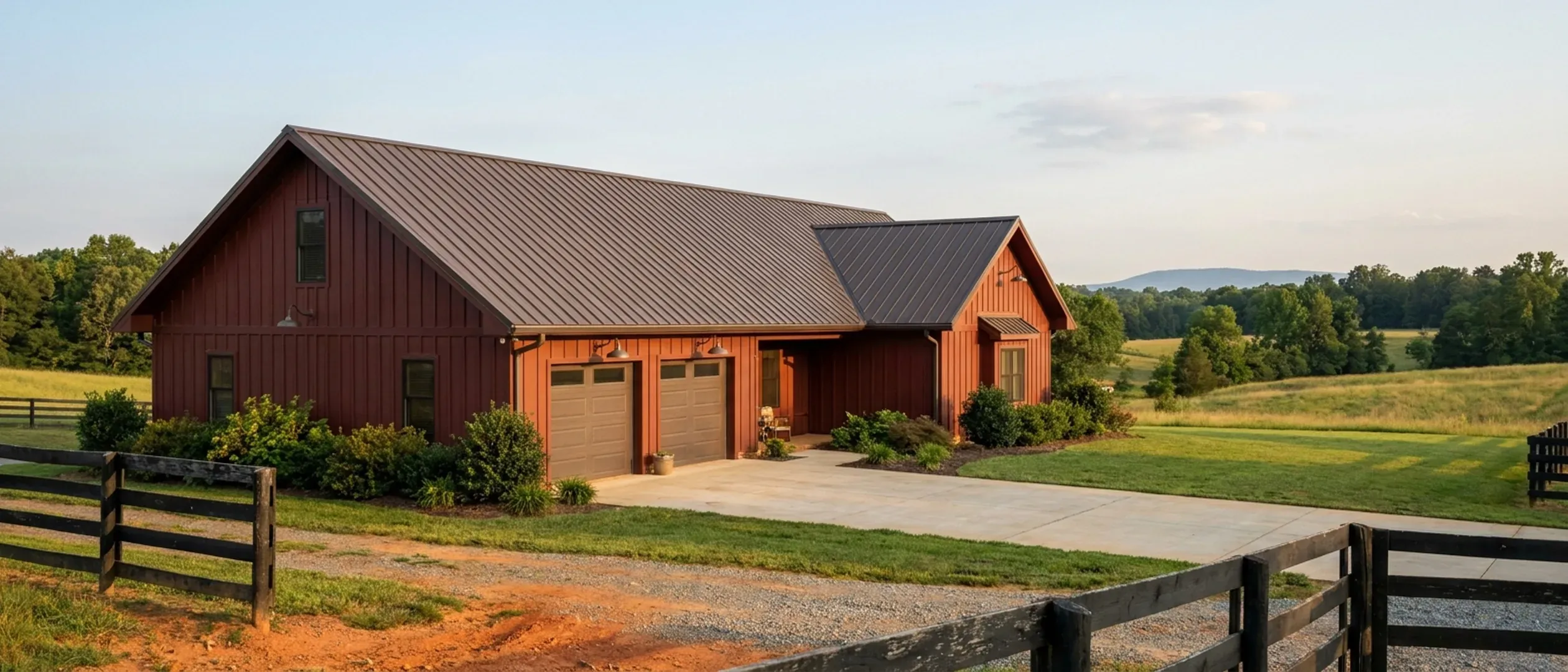
Are Barndominiums Worth It in Virginia?
If you have already weighed the building type, the next question is narrower and much more local: is it worth it here, on this parcel, for this program. Almost nothing about that answer is national. In Virginia it turns on whether the acreage you are looking at carries the right to put a dwelling on it at all, on what the ground under it does to a foundation and a drainfield, on the order the approvals happen in, and on whether the locality's zoning leaves room for the shop you actually want. Those are all knowable before you commit, several of them for the price of a letter. This page walks the decision in the order the money gets spent, and it ends by saying plainly when the answer is no.
Figures on this page are cited third-party or government data, not a quote from Virginia Barndominium Builders.
Bottom Line Up Front
- Acreage is not the same thing as the right to build. Fauquier County calculates permitted lots from the parent parcel as it existed on 21 May 1981, and Rappahannock pairs a two-acre minimum lot with a maximum density of one dwelling per twenty-five acres — so a lawful, sellable Virginia lot can carry a recorded covenant barring a dwelling on it forever.
- The three cheapest enquiries are the three that can end the project: a subdivision-potential or density determination where the county issues one (Fauquier publishes $55 where a prior letter dated 8 September 2005 or later exists for the property and $165 otherwise), a soil evaluation for the foundation and the drainfield, and the zoning district's accessory-structure section in writing.
- It is usually worth it where the shop is a genuine requirement and the rural district has no punitive accessory cap — the drainfield is sized on bedrooms, so shop area adds nothing to it. It is usually not worth it on a constrained lot, where minimum floor area, accessory caps, height limits and impervious-surface caps fight the form all at once.
First: acreage is not the same thing as the right to build
This is the single most expensive misunderstanding available in rural Virginia, and it is invisible on a listing. Counties here have zoning authority and several of them ration dwellings against a parent parcel as it stood on a date decades ago — so the number of acres you buy and the number of houses those acres carry are different numbers.
Fauquier rations dwellings against a 1981 parcel
Fauquier County § 2-308 sets a sliding-scale density in its RA and RC districts, and its operative sentence is the one to read twice: 'The basis for calculating the number of new lots allowed shall be the size of the parent parcel of record as of May 21, 1981.' If that parcel has been divided since, what remains is a proportionate share of what it originally carried. The scale itself runs from one lot at up to 9.99 acres to eleven at 205 acres and above. The practical consequence is blunt: forty acres carved out of a 300-acre 1981 farm may arrive at settlement carrying one right, or none, and buying more acres does not necessarily buy another house.
The county sells you the answer for the price of a letter
Fauquier's own instrument is the Subdivision Potential letter, which its zoning office is required to issue before agricultural or conservation land can be divided. Staff review the subdivision history and state 'the maximum number of lots, if any, that could be divided from the property' — the county's own drafting admits the answer can be zero — while warning that the figure is a theoretical maximum that drainfield sites, road frontage, floodplain and open-space requirements may not permit in practice. The county publishes a fee of $55 where a prior letter dated 8 September 2005 or later exists for the property and $165 otherwise. It is fast, it is cheap, and it belongs before closing rather than after.
Rappahannock pairs a two-acre lot with one dwelling per twenty-five acres
In Rappahannock County the agricultural district's minimum conventional lot is two acres — and its maximum density in the same chart is one dwelling unit per twenty-five acres, with § 170-22 doing the real work. The county's own guidance memorandum of 5 October 2023, from the county administrator and the zoning administrator, says the rule 'seems to cause community confusion' and then explains why: a parcel can be divided into any number of lots meeting the minimum acreage, width and yard requirements when dwellings are not contemplated, but a density analysis identifies which of the new lots must be tagged with deed restrictions disallowing future dwelling construction. So a two-acre Rappahannock lot can lawfully exist and lawfully be sold while carrying a recorded covenant that bars a dwelling on it forever. The check is the title, not the acreage.
And the rules can change under the land while you are looking
New Kent County raised its A-1 minimum lot area from one and a half acres to ten acres by an ordinance effective 1 July 2022 — while the convenience chart elsewhere in its code still prints the old figure. Both halves are true of different parcels: an existing lot of record remains buildable on its own dimensions, and a new A-1 lot is ten acres unless it comes through one of four named routes. That distinction is the whole practical difference between buying a recorded parcel and buying a farm to split. Chesterfield makes the same point from the other direction, having replaced its entire zoning ordinance effective 1 January 2026, rezoning every property in the county to the nearest equivalent new district.
Second: the ground and the water, before the offer
On an unsewered parcel the septic authorisation gates the building permit, and the soil decides both the drainfield and the foundation. These are the checks that change a purchase decision rather than a construction detail.
The septic authorisation comes first, and the health department issues it
The onsite sewage authorisation is the first approval in the sequence, not a parallel one, and it is the Virginia Department of Health that issues the permit — not the private soil evaluator who does the fieldwork. On a single-lot application the statute gives the department fifteen working days before the permit is deemed approved. One practical trap: the health district is not the planning district. Pittsylvania County, for instance, sits in the West Piedmont Planning District but in the Pittsylvania-Danville Health District, and the planning-district office is not where the septic permit comes from. Confirm the health district separately, from VDH, because it is the office you will actually be waiting on.
Replace the geography argument with measured soil data
The USDA's soil data is public, free and specific to your survey area, and it answers questions that reasoning from a geological map cannot. The worked example in the research for this site is Pittsylvania County: of 654,200 acres, soils with a horizon at high linear extensibility total 24,099 acres — 3.7 percent of the county — while 427,913 acres rate 'Very limited' for septic absorption fields and no acres at all rate 'Not limited', with seepage and slope as the dominant limitations rather than clay. That inverts the loose inference you would draw from the county sitting near a Mesozoic basin. Web Soil Survey is where a buyer can do the same check on a specific tract before making an offer.
Karst follows I-81, and geography does not reliably predict it
Virginia Energy publishes that most of the Commonwealth's karst region follows Interstate 81 and that twenty-seven of Virginia's counties lie in that zone, with VDOT having recorded roughly 500 road-damaging sinkholes in thirty years — including a nine-mile closure of I-81 in Augusta County in March 2001 after three sinkholes appeared, the largest twenty feet by eleven feet and twenty-two feet deep. But the belt is not the whole story: Loudoun County's karst is east of the Blue Ridge in the Culpeper Basin, and Loudoun is the one locality found requiring a geophysical study. If the parcel is in limestone country, the foundation investigation is a purchase-stage question, not a design-stage one.
Where a soil report is already a permit condition, treat it as information
Five localities make soil work a condition of the building permit, and the strictest of them requires a bored, sealed engineer's report on every new house in the county with no map opt-out. Where a locality has decided the risk is county-wide, it is telling you something about the ground that a listing will not. The corollary matters more: on a parcel where nobody requires a report, the ground is no better — the county has simply not put the requirement in writing, and Virginia Energy's own statement is that standard homeowner's cover does not reach damage from expansive or compressive soils.
Third: whether the building you want fits the place you are buying
Two localities can have identical building codes — in Virginia they always do — and completely different answers to whether your program is buildable. These are the questions that most often end the project quietly.
In the eight largest places, the honest answer is usually 'not here'
All eight incorporated places in Virginia over 100,000 people are independent cities, and they have essentially no buildable acreage. The 2022 Census of Agriculture counts three farms on three acres in Arlington. Petersburg is the clearest worked case: the largest by-right residential minimum lot in the city is 15,000 square feet, about a third of an acre, and reaching the agricultural district requires a minimum contiguous area of eight acres all zoned agricultural, with the city's published planning fee schedule listing a rezoning at $1,500. That is the real gate, and it is not the building code. If the shop-and-acreage program is the point, the search belongs in the counties.
Where the supply actually is
Four parts of Virginia carry most of the small rural tracts, and the 2022 Census of Agriculture gives the numbers rather than an impression. The Shenandoah Valley is the densest: Rockingham County alone reports 1,722 farms, 191,588 acres in farms, a median farm size of 46 acres and 886 operations under 50 acres. The Piedmont exurbs from Fauquier and Culpeper through Orange, Albemarle, Louisa and Madison have the highest demand and the most restrictive rural zoning. Southwest Virginia around Washington County, Wythe and Floyd has enormous supply and falling population. And the Richmond and Fredericksburg growth ring — Louisa, Goochland, Hanover, King William, New Kent, Caroline — is where supply and demand overlap most cleanly.
The accessory-structure rule decides the layout, and it is not portable
Whether the shop may be larger or taller than the house is a zoning question with a different answer in every locality, and it is the constraint that most often forces a redesign after the land is bought. Ask for it in writing, by section number, before the offer — along with the minimum heated floor area, the setbacks, and whether the district treats a shop with living quarters as a dwelling or as an accessory building. The classification decides which rule set applies to the whole project, and getting it settled at application is the difference between an ordinary permit and a special exception.
Private restrictions outlive public ones
Zoning is not the only instrument that reaches the exterior of a building, and recorded covenants are frequently stricter than any Virginia ordinance. Rappahannock's density mechanism is the sharpest illustration, because there the restriction that bars a dwelling is recorded against the lot itself rather than written in the zoning chapter. A title examination answers this and a zoning check does not, so both belong in the same week.
When it is worth it, and when it is not
The verdict this page owes the reader, stated as plainly as the evidence allows.
It is usually worth it when the program and the parcel agree
Where the shop is a real requirement rather than a preference — equipment, a trade, horses, storage that would otherwise be a second building — one structure doing two jobs is a genuine efficiency, and Virginia's septic sizing rewards it: the drainfield is sized from bedrooms, so shop area adds nothing to it. Add a rural district without a punitive accessory-structure cap, ground that will take a slab and a drainfield, and development rights that are actually attached to the acreage, and the arithmetic works in this building type's favour.
It is usually not worth it on a constrained lot
On a small urban or suburban lot the form fights every rule at once: minimum heated floor area, an accessory-structure cap measured against the house, height limits that require the shop to be shorter than the dwelling, impervious-surface caps, and in at least one Virginia city an architectural review of the exterior material. A building type whose advantage is span and volume gives up that advantage first. The land search, not the design, is the fix.
And it is not worth it on a parcel whose rights are already spent
If the density letter comes back at zero, or the title carries a covenant barring a dwelling, or the soil profile will not carry a drainfield and a reserve area, no amount of design solves it — and each of those is knowable before the money moves. That is the strongest argument for doing this sequence in order: the three cheapest enquiries in the process are the three that can end it.
What to have in hand before you sign
Six documents, and none of them is expensive: the zoning district and its accessory-structure section, in writing; the subdivision-potential or density determination where the county issues one; the locality's own climatic and geographic design criteria sheet; a soil evaluation, whether or not the locality requires one; confirmation of which office issues the septic authorisation and the building permit for that specific parcel; and a title examination that looks for recorded restrictions on dwellings and on exterior materials. Collected first, they answer 'is it worth it' with facts. Collected afterwards, they explain what went wrong.
Reading this because you are weighing a build? The next step is a plan drawn for your program.
What's different about Virginia
Development rights are dated instruments
Two of Virginia's rural counties ration dwellings against a parent parcel as it existed on a specific historic date — 21 May 1981 in Fauquier, 5 December 1986 in Rappahannock — and the county has to track the parcel's history back to that date to answer the question. Nothing about a listing, a plat or an acreage figure tells you what remains. Where the county issues a determination letter, that letter is the answer; where it does not, the subdivision history and the deed are.
The Chesapeake Bay Act boundary is the story, not the coast
Membership is a closed statutory list of 29 counties and 17 cities, and it reaches far inland: Arlington, Fairfax, Prince William, Stafford, Spotsylvania, Hanover, Henrico, Chesterfield and the City of Richmond are all on it, and Fauquier is not. A buyer moving one county west can leave the resource protection area regime behind entirely — and the inverse trap is just as real, because a locality off the list may still have a buffer by another instrument, as Rappahannock does with its stream protection overlay. Read the list; do not infer membership from a map.
Measured soil data beats geographic inference
Virginia's own geology page says the distribution of expansive soils can only be approximated from soil maps and that field visits are necessary to determine the actual extent. USDA soil data closes that gap at parcel scale, giving mapped shrink-swell potential, parent material and septic absorption-field limitation ratings by acre. It is the difference between 'this county is near a basin' and a number for the tract you are about to buy.
Growth rewrites the rules, and recently has
The rural districts a barndominium wants are exactly the districts fast-growing counties tighten. New Kent multiplied its A-1 minimum lot area by more than six in 2022; Chesterfield replaced its zoning ordinance outright with effect from 1 January 2026. Neither change touched the building code, because in Virginia no locality can, but both changed what could be built and on what. Check the adoption date on whatever ordinance you are relying on, and check whether an amendment is pending.
Are barndominiums a good investment in Virginia?
How do I know the land I am buying can actually have a house on it?
Is forty acres enough to build on?
Do I need a soil test if my locality does not require one?
Who issues the septic permit, and how long does it take?
Is it worth building a barndominium inside a Virginia city?
What would make a barndominium not worth it here?
Does the shop make the project more expensive to approve?
Questions answered? Tell us what you want to build and we will put real numbers against it.
Keep reading
The pages that answer the next question this one raises.
Barndominium pros and cons in Virginia
The companion page. Read it first if the question is still about the building type — wind, seismic, termites, moisture and what the ground does to a slab.
Read itSite preparation
What the soil work, the drainfield area and the pad actually involve once the parcel decision is made.
Read itPermitting
The approval sequence in order, and which office issues what in a county, a town and an independent city.
Read itWhere we build
The locality pages carry the district rules, the published design criteria and the accessory-structure caps county by county.
Read itWant a real number instead of a range?
Start your plans and we will come back with a budget for what you actually want to build, not a national average. Send the parcel ID or an address when you have one and we will price it against your land. That conversation costs nothing.