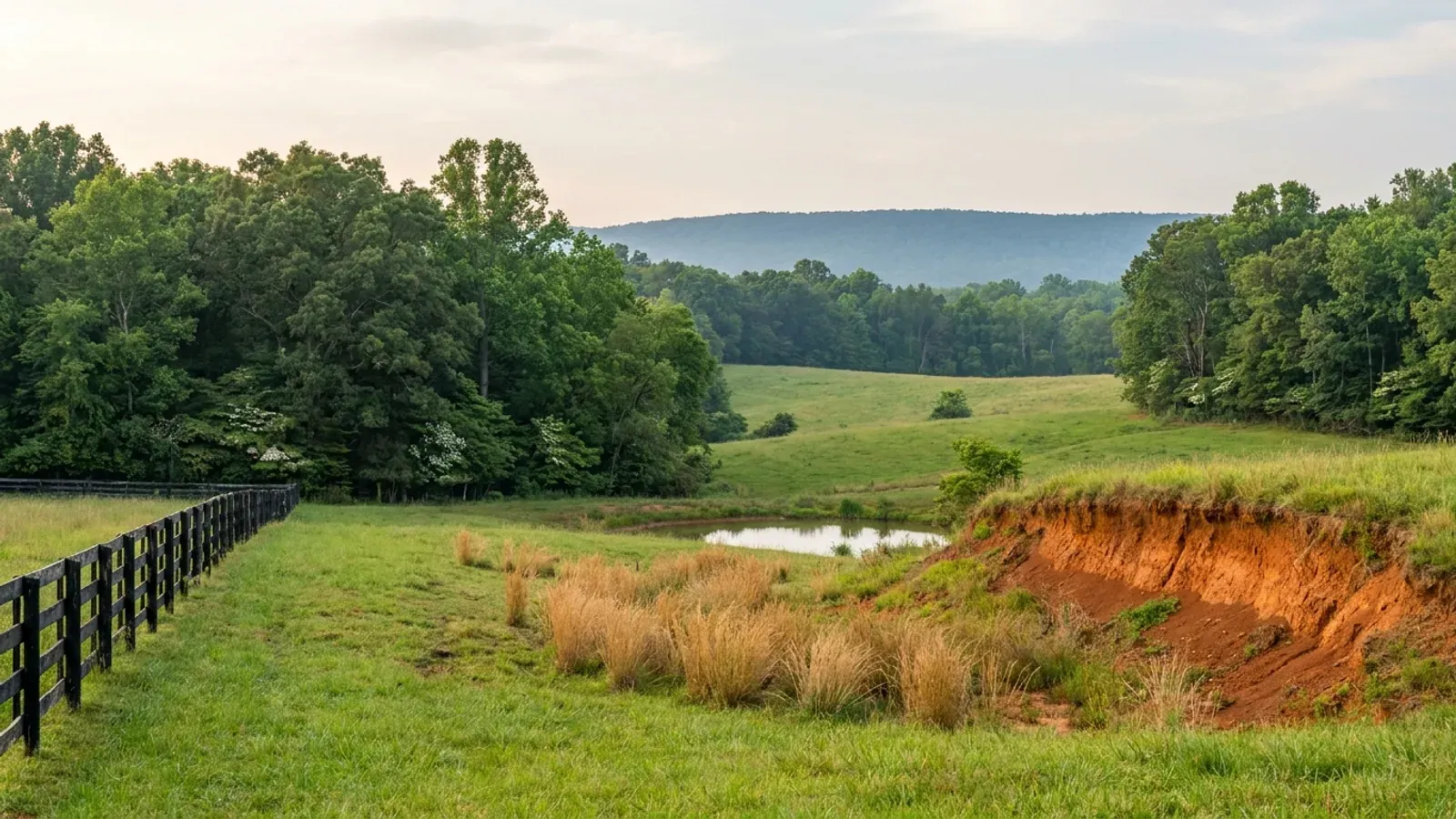
Barndominium Builders in Spotsylvania & Caroline Counties, VA
Spotsylvania and Caroline adjoin, share a planning district, share a health district, and share almost nothing else about building on them. Spotsylvania is the larger, faster-suburbanising half at 387 people per square mile, with only 15 percent of its land in farms but 167 farms under fifty acres and no maximum height at all on an agricultural building. Caroline is the acreage county at 65 people per square mile, 60,121 farm acres and a median farm of 53, where the Agricultural Preservation district asks a twenty-five acre minimum lot and a two-hundred-foot front setback. Both are on the Chesapeake Bay Preservation Act's statutory list, and even there they diverge: Spotsylvania designates every acre inside its boundaries a preservation area while Caroline maps a three-hundred-foot band. The City of Fredericksburg sits between them as an independent city in no county at all, ten square miles with no county authority over it and none reaching outside it, which is why the land answer here is always one county or the other.
Spotsylvania & Caroline Counties at a glance
- County
- Spotsylvania County
- Cities & counties covered
- Spotsylvania County 155,388 · Caroline County 34,413 · City of Fredericksburg 30,393
Building conditions in Spotsylvania & Caroline Counties
The building code itself is the same in every Virginia locality, and no county, city or town may amend it. What changes from one to the next is who issues the permit and inspects the work, what that office charges, how the parcel is zoned, and the Table R301.2 design criteria the locality publishes — the 2021 Virginia Residential Code prints that table blank, with the instruction that additional criteria shall be established by the local jurisdiction. Those local numbers are what your drawings have to satisfy.
Va. Code § 15.2-102; Va. Code § 36-105(A); U.S. Census Bureau Vintage 2025 population estimates (1 July 2025), city of Fredericksburg 30,393 over 10.4 square miles
Va. Code § 62.1-44.15:68 (raw text read 2 Sep 2026); Spotsylvania County Code Ch. 6A § 6A-4 (Ord. No. 6A-3, 2-10-04; Ord. No. 6A-6, 7-12-22) via api.municode.com, Supp. No. 136 codified through Ord. No. 23-192, 24 Feb 2026; Caroline County Zoning Ordinance Art. XV § 24-1.3.2 (adopted 05/12/92; as amended 05/09/2023)
Spotsylvania County Code § 6A-13(g), quoted in Spotsylvania County Community Development, Environmental Codes Division, Guidance Memorandum "Reserve Drainfield Requirements", Taylor Coxon, 2 April 2024 (updated 4/3/2024) — spotsylvania.va.us/DocumentCenter/View/28765; Caroline County Zoning Ordinance Art. XV § 24-1.6.B(7)
Caroline County Zoning Ordinance Article XII, Section 1 (Amended 01-13-2015; 06-14-2022); Spotsylvania County Code §§ 23-6.3.4, 23-6.4.4, 23-6.24.4 (Ord. No. 23-179 § 1, 4-14-20; Ord. No. 23-191 § 4, 5-27-25)
Spotsylvania County Code §§ 23-6.3.4(f), 23-6.4.4, 23-6.24.4(f); Spotsylvania County Zoning FAQs, spotsylvania.va.us/faq.aspx?TID=25; Spotsylvania County Fee Schedule (Land Use & Building) effective 1 July 2025; Caroline County Zoning Ordinance Article XII, Section 1
Caroline County Zoning Ordinance Art. XV § 4 (Amended 06/29/2026); Spotsylvania County Code § 23-5.2.2(2) (Ord. No. 23-160, 1-13-15; Ord. No. 23-191 § 3, 5-27-25)
Also worth knowing before you build in Spotsylvania & Caroline Counties
- Two encroachment windows that close one day apart
- Where the 100-foot RPA buffer would leave a lot with no buildable area, both counties allow a limited encroachment for older lots, and neither will let it reach the seaward fifty feet. Spotsylvania County Code § 6A-12(e) carries two windows: a lot recorded before 1 October 1989, and a lot recorded between 1 October 1989 and 1 March 2002. Caroline's adopted ordinance at Article XV § 24-1.6.C(8) carries only the pre-1-October-1989 route — the year 2002 does not appear anywhere in its Chesapeake Bay overlay text as amended 9 May 2023. Yet Caroline's own live Land Disturbing Activities form still prints a line for "Lots platted between 10/1/89 and 3/2/02." One county's ordinance says 1 March 2002, the other county's form says 2 March 2002, and the other county's ordinance says neither. There is no general "pre-2002 rule" in Virginia; there is only what your county's own instrument says.
- Neither county lets the shop come first
- Spotsylvania County Code § 23-5.2.2(1) says "No accessory structure shall be occupied or utilized unless the principal structure to which it is an accessory to is occupied and utilized." Caroline says it twice: Article XV § 4.2 provides that "An accessory use or structure shall not be established until the principle use or structure is established," and Article 5 § 4, the accessory-use list for the Agricultural Preservation district, closes with "No such accessory use or structure shall be permitted until the principal permitted use or structure has been established." The build-the-barn-first-and-live-in-it-while-you-finish sequence does not work in either county.
- In Spotsylvania a breezeway changes the building's legal classification
- Spotsylvania County Code § 23-5.2.3(1) provides that "If a building that otherwise would be considered accessory is attached to a principal building by any wall or roof construction, it shall be deemed to be a part of the principal building and shall comply in all respects with the requirements of this chapter applicable to a principal building." Connecting a shop to the house by a covered walk is therefore a zoning decision, not a design one: the setbacks, the height limit and the accessory rules all change. The same section bars any accessory structure from a minimum required front yard, and from any front yard at all on a lot of less than two acres, and requires a residential accessory structure to keep ten feet from rear and side lot lines.
- Run a business from the Spotsylvania shop and it shrinks by ordinance
- An ordinary detached shop in Spotsylvania is uncapped against the size of the house. A shop used for a home enterprise is not. Section 23-5.4A.2(a) says accessory buildings associated with a home enterprise "shall not be larger, in the aggregate, than fifty (50) percent of the gross floor area of the principle residential structure" and "shall not be more than twenty (20) feet in height," with the combined floor area used for the enterprise capped at seventy-five percent of the house. Only one home enterprise is allowed per parcel, the health department must certify the well and septic can carry it, and commercial garages, motor vehicle repair and tourist lodging are excluded by name. The quieter alternative, a home occupation under § 23-5.4.2, allows no customers or clients on site, no employees who do not live in the dwelling, and no exterior evidence of the use.
- Caroline's answer to a second unit is a 1,000 square foot family apartment
- Article 5 of Caroline's zoning ordinance lists a Family Apartment as a permitted accessory use in the Agricultural Preservation district, and Section 8 sets the terms: it may be occupied by no more than three persons, at least one of whom must be the parent, grandparent, child, grandchild, brother or sister of the owner and occupant of the single-family residence on the same lot; it "shall contain no more than 1,000 square feet of living space"; and "No dwelling units other than the principal structure (a single-family dwelling) and one such family apartment shall be located on a lot." Three years after it passes final inspection by the County Building Official, once no longer needed by the family, it becomes a nonconforming use and may be rented to anyone. A shop with living quarters for the owner is not this: that is the single-family dwelling, which is a permitted principal use in AP in its own right.
- The Town of Bowling Green zones, the county permits
- Caroline's county seat is an incorporated town, and towns in Virginia may or may not run their own building department. Bowling Green does not, and its own form says so twice. The Town of Bowling Green Zoning Permit Application issues a Certificate of Zoning Compliance under Chapter 126 of the Code of the Town of Bowling Green, signed by the Town's Zoning Administrator, and its applicant certification reads that "construction requires a building permit Issued by the Caroline County Building Official." Its closing reminder repeats the point: "Issuance of this permit does not mean work can begin. Permits must be obtained from the Caroline County Building Official." Spotsylvania has no incorporated towns at all, so the county is the only local government inside its lines.
- Spotsylvania's own Table R301.2, and Caroline's silence
- The 2021 Virginia Residential Code prints Table R301.2 blank, with em-dashes in every cell, and says the criteria shall be established by the local jurisdiction. Spotsylvania County's Building Safety Department publishes a filled-in sheet marked SC DC 01-09-2025: ground snow load 25, wind speed 115 mph, topographic effects NO, special wind region NO, windborne debris zone NO, seismic design category B, weathering SEVERE, frost line depth 18 inches, termite moderate to heavy, winter design temperature 17 degrees, ice barrier underlayment required YES, flood hazards FIRM 5-9-2023, air freezing index 312 and mean annual temperature 56.2 degrees. The same sheet publishes a Manual J block at elevation 270 feet, latitude 38 degrees north, with a 14-degree outdoor winter and 93-degree outdoor summer design dry-bulb. Caroline County publishes none of this. Every document its Building Inspections page offers was read, along with its nine-question Building FAQ, and not one carries a wind speed, a snow load, a frost depth or a seismic category. On a Caroline project those figures are settled with the Caroline County Building Official on the drawings, and Spotsylvania's are not a substitute.
- Weathering severe, and an ice barrier required
- Two rows on Spotsylvania's sheet separate it from the Tidewater localities it shares a statute with. Spotsylvania publishes weathering SEVERE and ice barrier underlayment YES, where the City of Chesapeake publishes moderate weathering and no ice barrier, and Mathews County publishes moderate to severe and No. Spotsylvania sits far enough up the Rappahannock to be a freeze-thaw county, and its 18-inch frost line and air freezing index of 312 say the same thing. Those rows drive real detailing on a metal-clad building: eave protection, footing depth and the way a slab edge is insulated.
- Not one acre in either county rates "Not limited" for a septic drainfield
- Measured from the USDA NRCS Soil Data Access service for the Caroline County (VA033) and Spotsylvania County (VA177) soil survey areas, weighted by component percentage. In Caroline, 227,064 acres rate Very limited for septic tank absorption fields and 87,267 acres Somewhat limited. In Spotsylvania, 122,826 acres rate Very limited and 96,694 acres Somewhat limited. Neither county has a single acre rated Not limited. Roughly 72 percent of Caroline's rated acreage is Very limited against about 56 percent of Spotsylvania's, so on the soil ratings alone the larger, more suburban county is the easier one to get a conventional drainfield through.
- The limiting feature is water, and in Caroline it is seepage
- Reading the same NRCS interpretation one level down, at the subrules that actually drive the rating, the two counties fail for different reasons. Caroline's largest limitation is seepage in the bottom layer at 122,689 acres — soil too permeable rather than too tight — followed by a near-surface water table at 120,090 acres, slope of 8 to over 15 percent at 65,095 acres and slow percolation at 63,246 acres. Spotsylvania's largest limitation is the near-surface water table at 86,988 acres, then seepage at 56,749, then flooding at 50,418 acres, which is a far bigger factor there than in Caroline. Spotsylvania also carries 11,070 acres over a cemented pan, a hardpan horizon that does not appear in Caroline's list at all. On a barndominium site the practical translation is drainage and water table, not clay.
- The Fall Line runs between the two counties, with a number on it
- Parent material, measured rather than inferred from a geology map. Caroline is 234,855 acres of loamy marine deposits with 67,936 acres of alluvium and only 16,124 acres of granite and gneiss residuum: it is Coastal Plain. Spotsylvania is 97,637 acres of residuum weathered from granite and gneiss, 36,110 acres from mica schist, 30,968 acres of alluvium and 13,546 acres of mixed mafic residuum, with 26,884 acres of loamy marine deposits along its eastern edge: it is Piedmont crystalline rock with a Coastal Plain fringe. The county line is a geological boundary as well as an administrative one, and it is why the two counties fail their septic ratings for different reasons.
- Shrink-swell is marginal here, but Spotsylvania's little bit is the bad kind
- Measured against the linear extensibility percentage, the soil property that actually drives foundation movement, soils with any horizon at 6 percent or more total 1,916 acres in Caroline and 2,281 acres in Spotsylvania — well under one percent and about one percent of mapped acreage respectively. Neither is a shrink-swell county, and neither is among the localities Virginia Energy names. But the series matter. Caroline's is Helena, topping out at 7.5 percent. Spotsylvania's are Orange at 7.5 percent and Iredell at 17 percent — a very high shrink-swell soil — sitting on the county's 13,546 acres of mafic residuum, which is the same mechanism behind Loudoun's diabase problem. Neither county runs a shrink-swell policy or publishes a soils map, so this is a reason to have a parcel-level soils check done rather than a permit gate to clear.
- Where each county's acreage actually is
- USDA's 2022 Census of Agriculture separates the two clearly. Caroline has 60,121 acres in farms across 527 square miles, 17.8 percent of its land, on 214 farms averaging 281 acres with a median of 53, at 65 people per square mile. Spotsylvania has 39,666 acres in farms across 402 square miles, 15 percent of its land — the lowest share in the Fredericksburg ring — but on 281 farms averaging only 141 acres with a median of 40, and 167 of those operations are under fifty acres against Caroline's 98. Spotsylvania also holds more woodland inside farms, 14,238 acres against 12,336. Caroline is where the large tracts are; Spotsylvania is where the small ones are, at 387 people per square mile and growing 10.5 percent since 2020 against Caroline's 11.3 percent.
- Caroline's farm-building affidavit has a conversion clause
- Va. Code § 36-97 defines a farm building as one "not used for residential purposes," which is why the agricultural exemption does not survive anyone moving in. Caroline puts the consequence in writing. Its 2025 Affidavit of Farm Building or Structure has the applicant affirm an intent to build a structure "not used for residential purposes" on land where farming operations take place, then adds: "I understand and agree that if the primary use of the Structure is no longer used for one or more of the reasons listed above, I must apply for a change of use permit with the Caroline County Department of Planning and Community Development and submit plans, acquire permits and pay the appropriate fees." The county pairs it with an acreage gate on the fee schedule — an agricultural structure permit is available only where the parcel is five acres or more — and prices a change-in-use permit at $102. Spotsylvania's equivalent gate is on the zoning side: two acres for a non-livestock farm structure, five for livestock, with a "Farm Exempt" zoning review at $55.
- Two fee schedules that share no row
- Spotsylvania's Fee Schedule (Land Use & Building) effective 1 July 2025 charges a new single-family home at $0.57 per square foot of Gross Building Area with a $285 minimum, and that one figure includes all trades, construction and plan review. Additions and accessory structures are charged at exactly the same $0.57. The definitions page explains why that matters: Gross Building Area means "The total area of each floor including the basement and all exterior structures, (such as decks, porches, garages, sheds, etc.)" — so the shop is priced like the house. Caroline's fee schedule, adopted 12 June 2012, charges $0.15 per square foot for a dwelling's first floor, second floor and unfinished areas alike with a $100 minimum, then prices electrical, plumbing and mechanical separately at $75 each per dwelling unit, and charges accessory structures — the schedule names storage sheds over 200 square feet, detached garages and workshops — at $0.12 per square foot. In Caroline a detached shop is cheaper per square foot than the house; in Spotsylvania it costs exactly the same. Both counties add the 2 percent state levy.
- Building without a permit is priced differently in each county
- Spotsylvania charges a flat $300 Notice Violation Fee, described in the schedule as "Charged for failure to obtain a required permit prior to performing construction work," plus $300 for a stop work order and $100 for each re-inspection. Its environmental side is heavier: land disturbance without a permit is $1,150, an RPA encroachment violation is $900, and a single-family detached residential erosion and stormwater inspection package is $1,675 covering pre-construction, first, occupancy and bond release inspections plus the first year of scheduled inspections. Caroline's post-construction permit fee for work done without a permit is twice the permit fee or $250, whichever is greater, with $100 per failed re-inspection payable within thirty days or all inspections stop.
- Caroline publishes a permit turnaround; Spotsylvania does not
- Caroline County's Building FAQ answers the question directly: "If your permit application is complete and has no issues during plan review that would require additional submittals, you can expect a residential permit within 21 days and a commercial permit within 45 days." Spotsylvania publishes no plan-review timeframe anywhere on its Applying For a Permit page, which instead sets out the application process and requires a paper copy of all approved plans and the permit card on site for the inspectors, printed to scale and carrying the County Approved Stamp. Two counties, one published service standard.
- What Caroline wants in the folder before it will start
- Caroline's 2024 Single Family Dwelling packet lists it: the septic and well permit, two copies of construction plans, two copies of a site plan drawn to scale, the Land Disturbing and Zoning Plan Checklist, a signed Agreement in Lieu of an E&S Plan and Agreement in Lieu of a Stormwater Management Plan, the water quality impact assessment form if the work encroaches on an RPA buffer, the deed, evidence that any delinquent real estate taxes are paid, a $1,400 erosion and sediment control bond and a $200 plan review deposit. On lots of three acres or less the house location must be surveyed and the site plan prepared by a certified land surveyor or professional engineer at one inch to thirty feet, showing wells, septic tanks and drainfield areas including reserve areas, the CBPA designation, the RPA boundary and contours at ten-foot intervals; under one acre it drops to two-foot contours with proposed floor elevations and foundation drain outfalls. A VDOT land use permit is needed before any entrance is cut off a state-maintained road.
- A perennial stream costs you a 200-foot corridor in either county
- The Resource Protection Area buffer runs one hundred feet on both sides of any water body with perennial flow, so a stream crossing a parcel takes a two-hundred-foot-wide strip out of the buildable area. Spotsylvania's § 6A-5(d) applies the buffer "along both sides of any water body with perennial flow" and § 6A-12(c) says it "shall not be reduced in width," deeming it to achieve a 75 percent reduction of sediments and 40 percent of nutrients. Caroline's § 24-1.3.1.A(4) sets the same hundred-foot buffer and § 24-1.6.C(6) likewise says it may not be reduced. Both counties also set their land-disturbance trigger at 2,500 square feet rather than the 10,000 that applies in non-Bay-Act Virginia — Caroline requires a plan of development process above 2,500 square feet "prior to site clearing or grading or the issuance of any building permit," and Spotsylvania requires full erosion and sediment control compliance at the same threshold.
- Even the conservation district is different
- Spotsylvania's ordinance works with the Tri-County City Soil and Water Conservation District, which is named in § 6A-12 as the body that helps set a compliance schedule where a buffer has to be reestablished. Caroline's works with the Hanover-Caroline Soil and Water Conservation District, named in § 24-1.6.B(11) as the body that prepares the soil and water quality conservation assessment required for land in bona fide agricultural use. What the two counties do share is the health district: Caroline, King George, Spotsylvania and Stafford counties and the City of Fredericksburg are all in the Virginia Department of Health's Rappahannock Area Health District, which is where the septic permit comes from in every one of them.
- Radon: Spotsylvania is EPA Zone 1, Caroline is Zone 3
- EPA's county table puts Spotsylvania in Zone 1, the band with a predicted average indoor screening level above 4 pCi/L, and Caroline in Zone 3, below 2 pCi/L. That does not make radon-resistant construction a code requirement in Spotsylvania. Virginia Residential Code R331.1 needs two things at once: an EPA Zone 1 area and the locality having taken official action under the zoning article of Title 15.2. Eleven Virginia localities have. Spotsylvania's published adopted-codes list carries no radon appendix and no such action was found in its zoning chapter or its Chesapeake Bay chapter. Testing a Spotsylvania build is sensible on the geology; it is not something the code makes anyone do.
- Caroline has a 25-acre overlay along the Rappahannock corridor
- Article XV Section 19 of Caroline's zoning ordinance, adopted 23 July 2002 and amended through 9 December 2025, creates a Resource Sensitive Area Overlay District covering the Route 17 and Rappahannock River Valley corridor, bounded by the Spotsylvania County line, the river, the King George and Essex county lines, the Fort A.P. Hill boundary and Snow Creek. Inside it the ordinance says "The lot area and other dimensional requirements shall be the same as those requirements set forth in the underlying zoning district(s) except that the minimum lot size shall be twenty-five acres." It overlays whatever district is beneath it, so a parcel can be RR-2 and still carry a twenty-five acre floor. Spotsylvania has no equivalent.
- A superseded contractor threshold on a current county form
- Caroline's Contractor Affidavit, bound into both its 2024 dwelling packet and its 2025 agricultural structure packet, prints Class A contracting as $120,000 in a single contract or $750,000 in twelve months, Class B as $10,000 to $120,000, and Class C as over $1,000 to $10,000. Va. Code § 54.1-1100 sets Class A at $150,000 single contract or $1,000,000 in any twelve months, Class B at $30,000 to under $150,000 or $250,000 to under $1,000,000, and Class C at over $1,000 to under $30,000. The $120,000 and $750,000 figures survive verbatim in § 54.1-1103(C) for two narrow trades only, water well construction and landscape irrigation, which is why a well driller and a house builder on the same site are under different numbers. The affidavit is right about the thing that bites: § 54.1-1111 prohibits an awarding authority from issuing a permit to a contractor who is not properly licensed, and licensure is required before anyone may bid or undertake contracting work of $1,000 or more.
- Slopes over 15 percent are a Caroline zoning trigger, not a building one
- Neither county publishes a steep-slope construction standard. What Caroline does have is an environmental one: Article XV § 24-1.3.2.A(2)(d) lists "Steep slopes in excess of 15%" among the land types its Chesapeake Bay overlay pulls into the Resource Management Area, alongside floodplains, highly erodible soils, highly permeable soils and non-tidal wetlands. And § 24-1.3.2.C lets the Director deem an entire parcel to be in the RMA where only part of it falls inside the mapped band. So on a sloping Caroline parcel the slope is what puts the whole property inside the programme, with its plan of development, its 2,500 square foot disturbance trigger and its unbuildable reserve drainfield. Slope also shows up in the soil data: 65,095 acres of Caroline rate a septic limitation for slope of 8 to over 15 percent, against 25,111 acres in Spotsylvania.
Spotsylvania County Code § 6A-12(e)(1)–(2); Caroline County Zoning Ordinance Art. XV § 24-1.6.C(8); Caroline County Land Disturbing Activities / CBPA form, bound into the 2024 Single Family Dwelling Application Packet, co.caroline.va.us/DocumentCenter/View/954
Spotsylvania County Code § 23-5.2.2(1); Caroline County Zoning Ordinance Art. XV § 4.2 and Art. 5 § 4 (as amended through 29 June 2026)
Spotsylvania County Code §§ 23-5.2.3(1), 23-5.2.3(7)(A)–(B) (Ord. No. 23-160, 1-13-15; Ord. No. 23-191 § 3, 5-27-25)
Spotsylvania County Code §§ 23-5.4A.2(a), 23-5.4A.2(d)–(j), 23-5.4.2 (Ord. No. 23-160, 1-13-15)
Caroline County Zoning Ordinance Article 5, Sections 3, 4 and 8 (as amended through 29 June 2026)
Town of Bowling Green Zoning Permit Application, form revised 28 April 2008 — townofbowlinggreenva.gov/media/736 (host control-tested: bogus media id and nonsense slug both return HTTP 404 at 31,889 bytes)
Spotsylvania County Building Safety Department, Table R301.2(1) Climatic and Geographic Design Criteria, sheet marked SC DC 01-09-2025 — spotsylvania.va.us/DocumentCenter/View/32538; Caroline County Building Inspections document set and Planning Department Building FAQs, co.caroline.va.us/406 and /faq.aspx?TID=17 (read 2 Sep 2026)
Spotsylvania County Building Safety Department sheet SC DC 01-09-2025; comparison figures from City of Chesapeake Residential Plan Review Checklist and Mathews County Local Design Criteria as recorded in research/statewide/design-criteria-and-climate.md
USDA NRCS Soil Data Access, sdmdataaccess.sc.egov.usda.gov/Tabular/post.rest, interpretation "ENG - Septic Tank Absorption Fields" at ruledepth 0, survey areas VA033 and VA177, queried 2 Sep 2026 (control: a bogus areasymbol returns HTTP 200 with an empty result)
USDA NRCS Soil Data Access, "ENG - Septic Tank Absorption Fields" subrules at ruledepth 1 with full restriction, survey areas VA033 and VA177, queried 2 Sep 2026
USDA NRCS Soil Data Access, copmgrp parent material groups at rvindicator = Yes, survey areas VA033 and VA177, queried 2 Sep 2026
USDA NRCS Soil Data Access, chorizon.lep_r >= 6 by component and by series, survey areas VA033 and VA177, queried 2 Sep 2026; Virginia Energy expansive soils material as recorded in research/statewide/soils-karst-and-slopes.md
USDA NASS 2022 Census of Agriculture, county-level file (acres operated, percent of total land, farms, average and median acres per operation, woodland in farms, operations under 50 acres); U.S. Census Bureau Vintage 2025 population estimates
Caroline County Department of Planning & Community Development, Affidavit of Farm Building or Structure, 2025 Agricultural Structure Application Packet — co.caroline.va.us/DocumentCenter/View/1022; Caroline County Fee Schedule § 29-1 (adopted 12 June 2012); Spotsylvania County Zoning FAQs and Fee Schedule effective 1 July 2025; Va. Code § 36-97
Spotsylvania County Fee Schedule (Land Use & Building) Effective July 1, 2025, pp. 1 and 13 — spotsylvania.va.us/DocumentCenter/View/34296; Caroline County Department of Planning & Community Development Fee Schedule § 29-1 (adopted June 12, 2012) — co.caroline.va.us/DocumentCenter/View/397; Va. Code § 36-137
Spotsylvania County Fee Schedule effective 1 July 2025, Building Administrative Fees, Environmental and Other Environmental Fees; Caroline County Fee Schedule § 29-1 A.4 and § 29-2
Caroline County Planning Department Building FAQs, question 7 — co.caroline.va.us/faq.aspx?TID=17; Spotsylvania County, Applying For a Permit — spotsylvania.va.us/226
Caroline County Department of Planning & Community Development, 2024 Single Family Dwelling / Industrialized / Modular Building Application Packet, Application Check List and Land Disturbing & Zoning Plan Checklist — co.caroline.va.us/DocumentCenter/View/954
Spotsylvania County Code §§ 6A-5(d), 6A-12(c), 6A-15(a)(2)(d); Caroline County Zoning Ordinance Art. XV §§ 24-1.3.1.A(4), 24-1.6.C(6), 24-1.8; 9VAC25-830-80
Spotsylvania County Code § 6A-12; Caroline County Zoning Ordinance Art. XV § 24-1.6.B(11); Virginia Department of Health, Rappahannock Area Health District — vdh.virginia.gov/rappahannock/
EPA county radon zone table as transcribed in research/statewide/design-criteria-and-climate.md; Virginia Residential Code R331.1 via 13VAC5-63-210; Spotsylvania County, Adopted Codes for Spotsylvania County — spotsylvania.va.us/222
Caroline County Zoning Ordinance Article XV, Section 19 (Adopted 07/23/02; as amended through 12/09/2025)
Caroline County Contractor Affidavit, 2024 Single Family Dwelling packet and 2025 Agricultural Structure packet; Va. Code §§ 54.1-1100, 54.1-1103(C), 54.1-1111
Caroline County Zoning Ordinance Art. XV §§ 24-1.3.2.A(2)(d), 24-1.3.2.C; USDA NRCS Soil Data Access, "ENG - Septic Tank Absorption Fields" slope subrule, survey areas VA033 and VA177
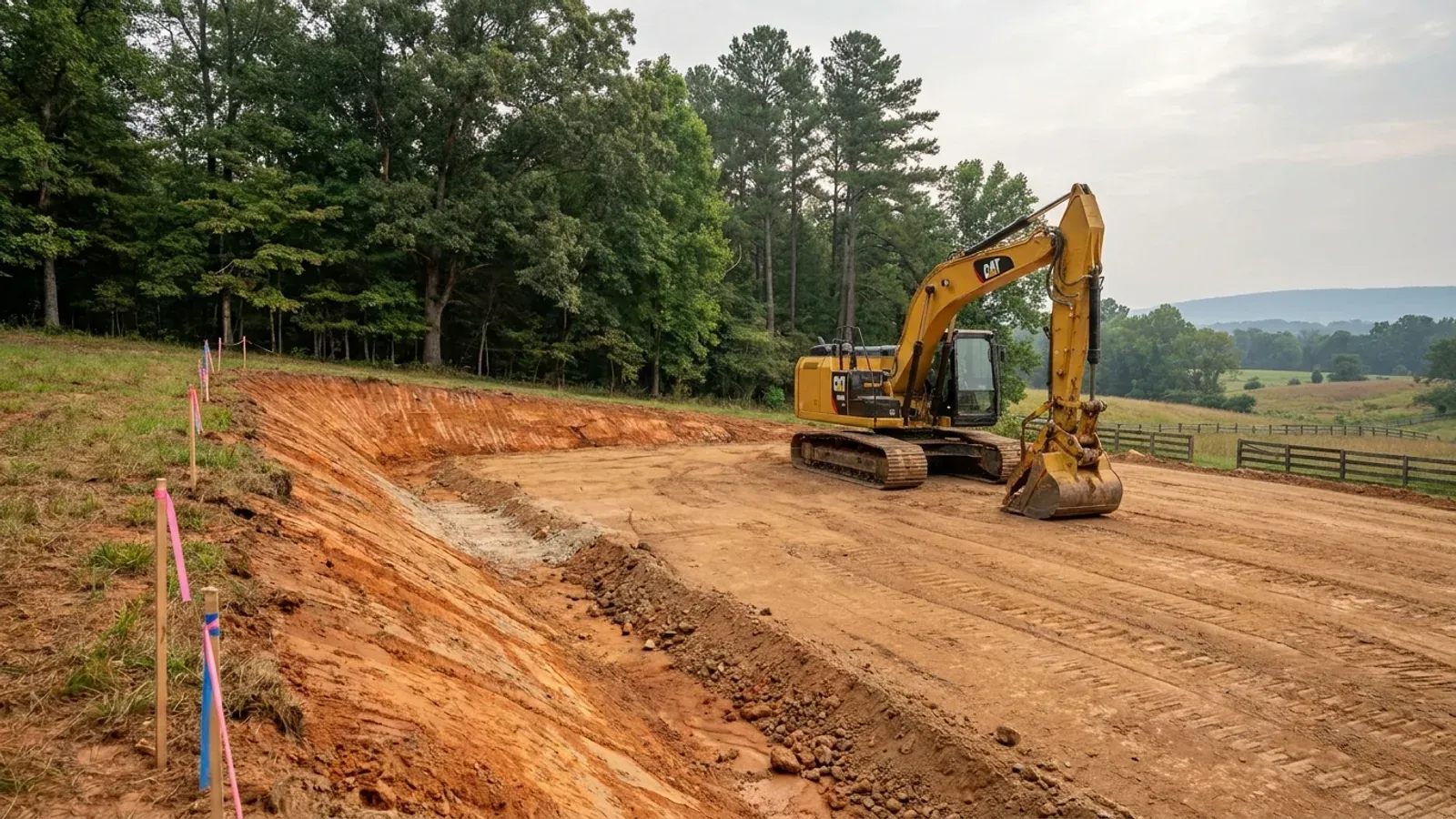
The expensive surprises are in the ground, not the building
What moves a Virginia budget is usually below grade, and it is soil rather than rock. Five localities already treat a soil answer as a condition of the permit rather than a recommendation — Fauquier, Chesterfield, Isle of Wight, Madison and Culpeper each require a soil report, an engineered foundation design, or both before the footings are approved. Chesterfield asks for one on every new house with no opt-out, on its own published reasoning that small amounts of shrink-swell soil may turn up anywhere in the county. Virginia Energy puts the same point bluntly: standard homeowner's insurance does not cover damage from expansive or compressive soils. Along the Interstate 81 corridor the question changes shape entirely — Virginia Energy counts twenty-seven Virginia counties in the karst zone that follows that road, where what matters is what is under the slab rather than what the slab sits in, and karst does not stay west of the Blue Ridge: Loudoun County publishes karst terrain of its own, on the other side of it. The same ground then sizes the septic system, because 12VAC5-610 works from bedrooms and soil texture — 150 gallons a day per bedroom, with no row in the table for a shop, a garage or a barn at all, and clay assigned to the slowest texture group at 91 minutes per inch or worse, past the 45 minutes per inch that makes a reserve drainfield mandatory. The soil that needs a foundation engineer multiplies the drainfield. So the site work, the foundation and the drainfield get resolved together rather than one at a time. We price the dirt before we price the building.
What we build in Spotsylvania & Caroline Counties
All nine services are available in Spotsylvania & Caroline Counties. What a build costs depends far more on the parcel than on square footage, so we price against your land rather than publishing a rate card.
Custom Plans
Barndominium floor plans drawn to your parcel and to the design criteria your own Virginia locality publishes, not to a generic national spec.
Barndominium Kits
Engineered barndominium shell packages delivered to your Virginia land, drawn to the criteria your own building department fills in.
Turnkey Builds
Start to finish barndominium construction: permits, site work, shell and full interior finish, under one contract and one schedule.
What a build looks like
Three stages every Spotsylvania & Caroline Counties project passes through, from a raw parcel to a finished home. Site work first, because that is where the budget is decided.
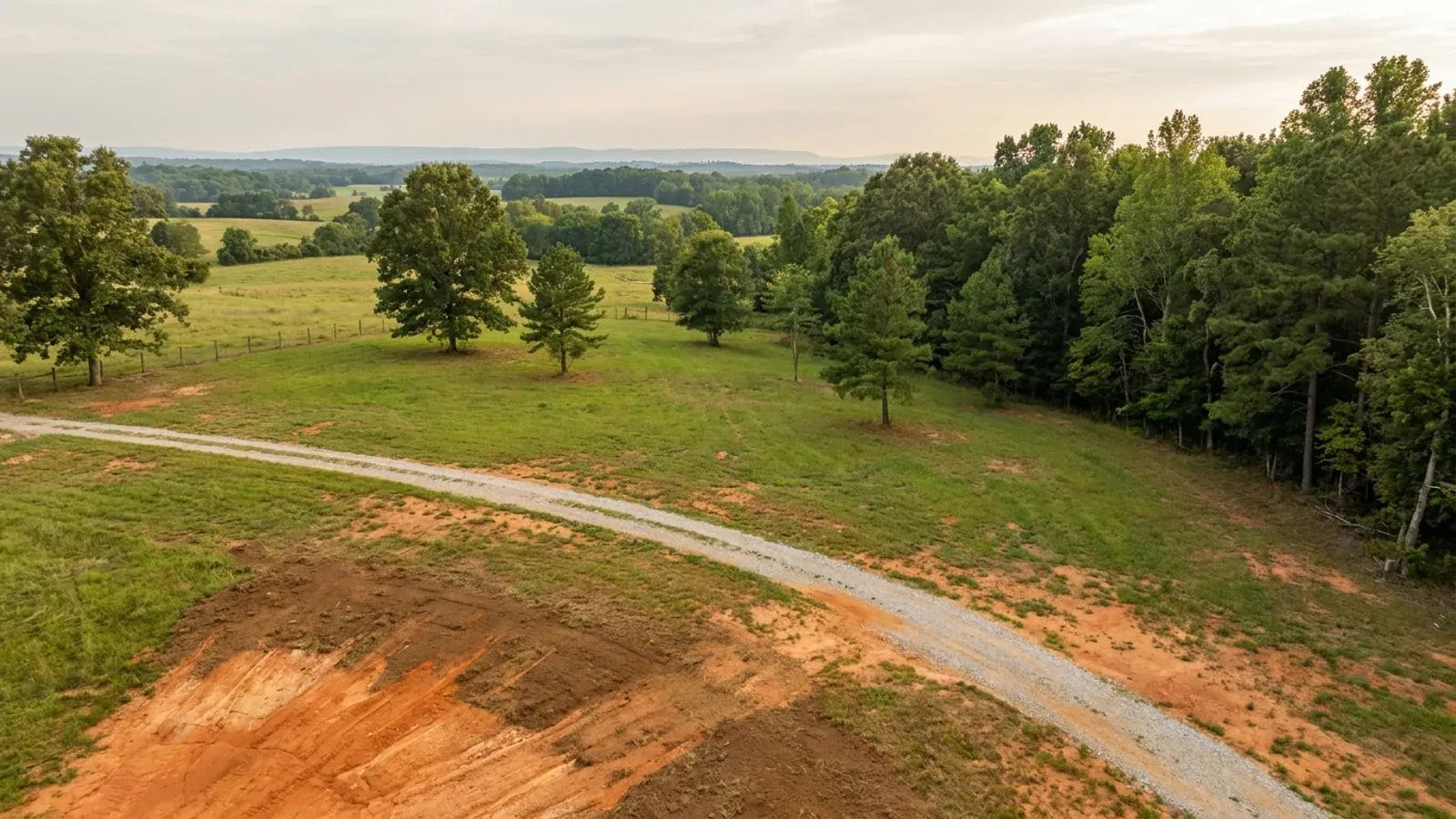
The parcel
Zoning, setbacks, flood zone and utility access get checked before anything is drawn.
Pad and permit
Clearing, grading and a compacted pad, while the submittal works through whichever office issues the permit where you are building.
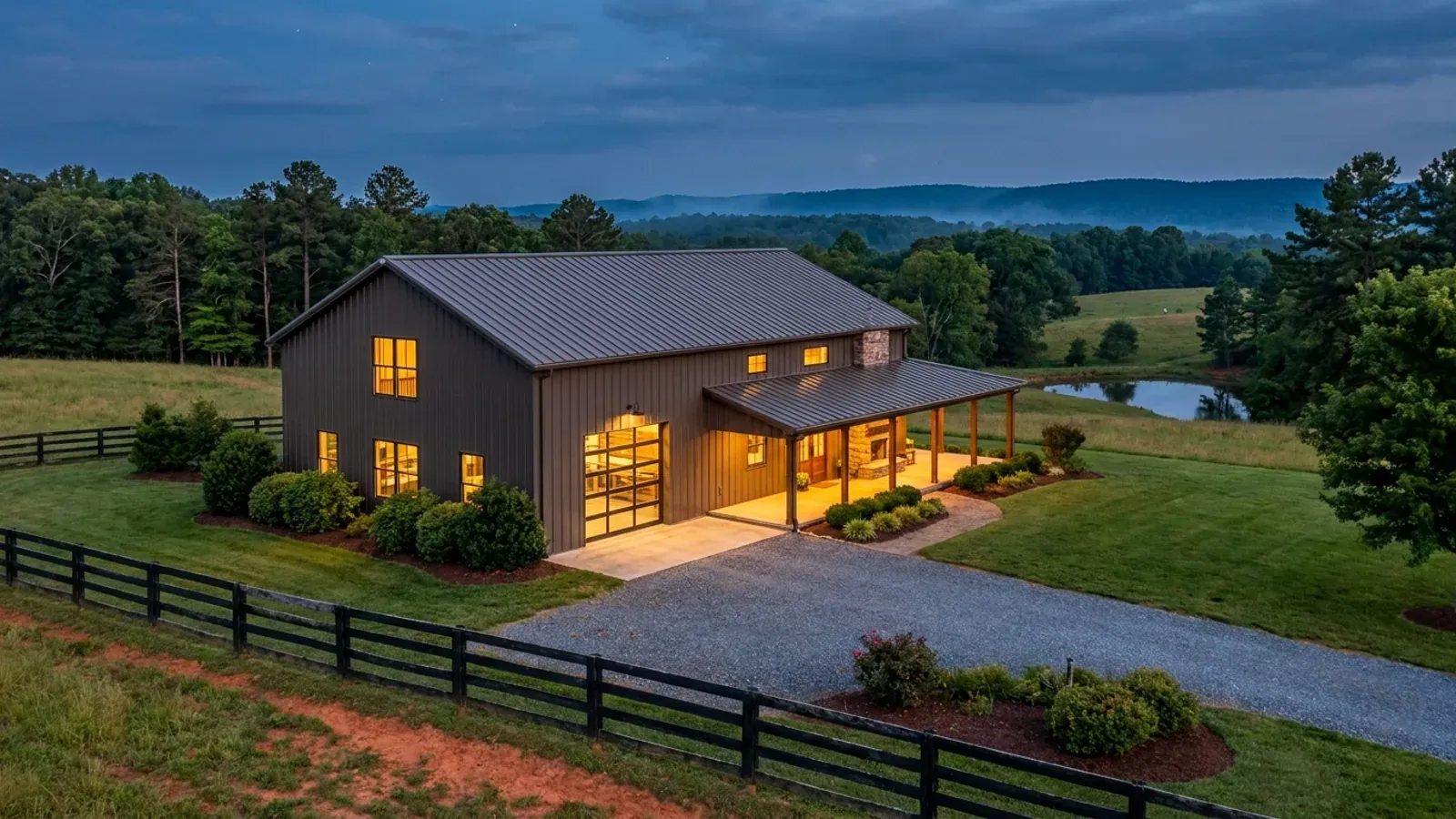
Frame to finish
Shell erected and dried in, then systems, insulation and interior finish through to CO.
Those are the rules where you are building in Spotsylvania & Caroline Counties. Tell us what you want to build and we will draw it to them.
Where we build around Spotsylvania & Caroline Counties
Spotsylvania County and the rural land around it. The buildable acreage for a project this size usually sits outside the city limits, which is frequently what changes who issues your permit.
Keep reading
The questions that usually come next once you know what Spotsylvania & Caroline Counties allows.
Barndominium Cost Guide
Sourced per-square-foot ranges by tier and by size, with a calculator built on the same figures.
Read itIs It Legal in Virginia?
Classification, zoning, the HOA gate, and why "nonresidential farm building" does not cover a home.
Read itHow Long Does It Take?
Census build-duration data, and what actually sets the permit clock where you are building.
Read itNearby areas we build in
Others we cover nearby. One may be a county, another an independent city that belongs to no county at all, and another a town inside a county — so the office that issues the permit, the fees it charges, the zoning and the design criteria each locality publishes can all differ from one card to the next.
Building in Spotsylvania & Caroline Counties: common questions
9 questions we get asked most often about building in Spotsylvania & Caroline Counties. If yours is not on the list, ask it directly.
I want to build a barndominium near Fredericksburg. Which county do I actually deal with?
How much land do I need for a house and a shop in each county?
Can the shop be bigger than the house?
Can I put up the shop first and live in it while I finish the house?
Both counties are in the Chesapeake Bay Act. Does that mean the same thing on both sides of the line?
What is the soil actually going to do to my septic system?
Should I be worried about expansive clay here?
What will the permit cost, and how long will it take?
Do I deal with the Town of Bowling Green if I build inside it?
Building in Spotsylvania & Caroline Counties?
Start with the plan. Tell us what you want to build and we will draw it, then confirm which office issues the permit for your parcel, what it will let you put there, and what wind load it has to meet. That conversation costs nothing.